

ATV Wholesale Buying Guide: 12 Questions Every Distributor Should Ask Before Importing
Before importing ATVs in bulk, do not judge a supplier by FOB price alone. A serious wholesale ATV evaluation should cover compliance, supplier identity, spare parts, warranty terms, inspection, packaging, documentation, dealer support, and true landed cost.
Executive Summary
Choosing a wholesale ATV supplier based only on unit price is one of the most expensive mistakes a distributor can make. The FOB price on a proforma invoice does not show the full cost of importing, distributing, and supporting ATVs through a dealer network.
This ATV wholesale buying guide is written for importers, regional distributors, powersports dealers, farm equipment wholesalers, rental fleet buyers, e-commerce bulk sellers, and private-label sourcing managers. It gives buyers a practical due-diligence framework before they commit to a sample order, mixed container, or full container program.
Non-compliant shipments, missing spare parts, unclear warranties, damaged packaging, weak documentation, and hidden landed costs.
Model-specific documents, parts catalogs, written warranty terms, PSI checklists, packaging photos, dealer materials, and clear lead-time commitments.
Request the model list, MOQ, spare parts catalog, warranty policy, packaging photos, and available compliance documents before paying a deposit.
Why ATV Wholesale Decisions Go Wrong
The global ATV wholesale market attracts buyers from every channel: powersports dealers sourcing seasonal inventory, importers filling containers for a regional network, farm equipment dealers expanding into utility vehicles, rental fleet buyers seeking durable units, and private-label buyers building their own brand on a supplier platform.
The risk is that many sourcing conversations start with one question: “What is your FOB price?” That is the wrong starting point. A low unit price can become expensive if the supplier cannot support compliance documentation, parts availability, warranty claims, packaging quality, or model continuity.
The U.S. Consumer Product Safety Commission notes that OHV/ATV risks include overturning, collisions, and occupant ejection, and reports annual averages of more than 800 deaths and about 100,000 emergency-department-treated injuries involving OHVs. Those figures matter to wholesale buyers because they explain why safety documentation, age-appropriate product categorization, dealer education, and traceability matter in regulated markets. Source: CPSC OHV & ATV Safety Information Center.
1Does the ATV Meet Your Target Market’s Compliance Requirements?
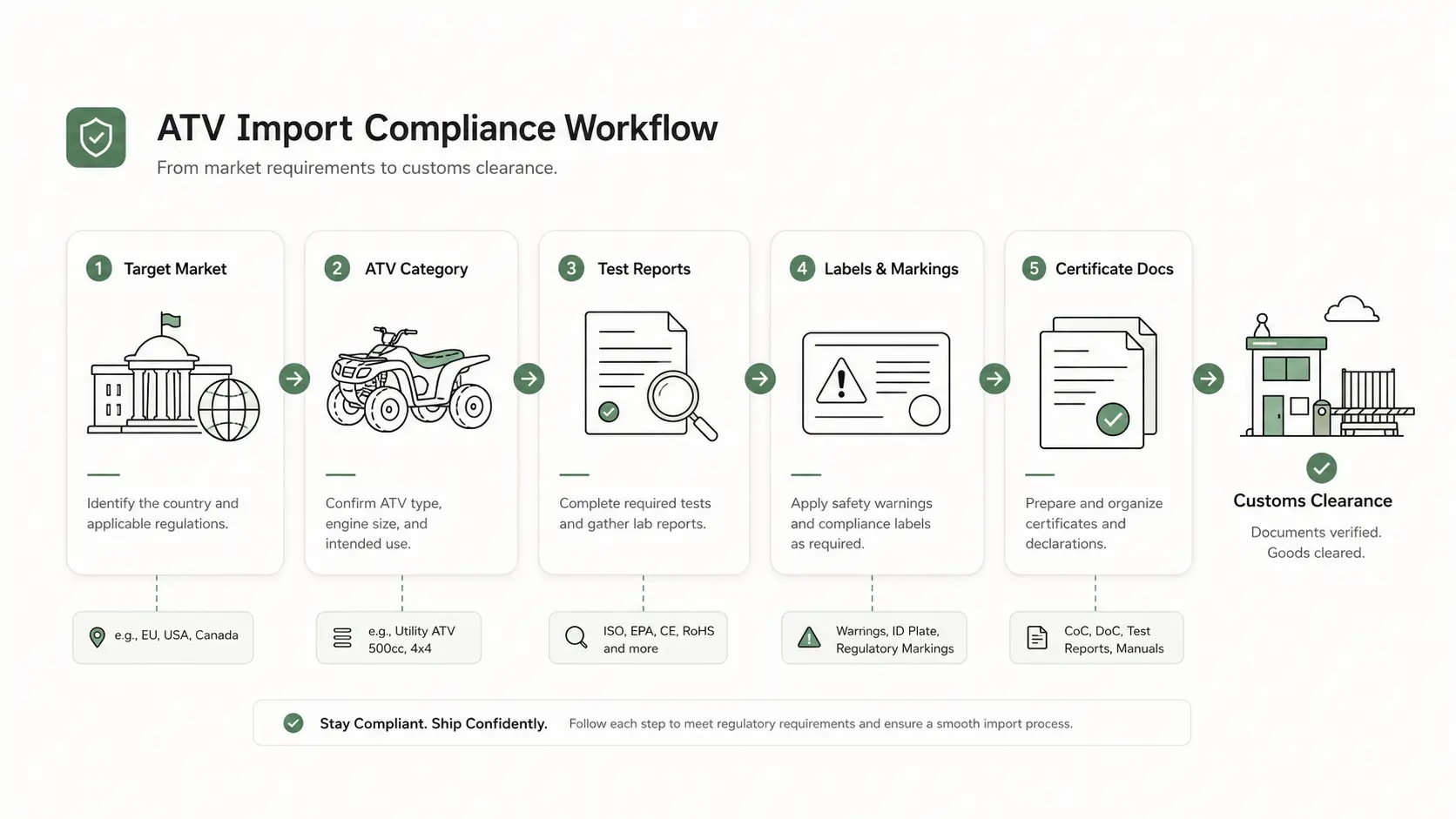
Compliance is the first question because it can stop the entire business model. A non-compliant ATV shipment may create customs delays, retailer refusal, enforcement risk, recall exposure, or a container of inventory that cannot be sold in the target market.
For U.S.-bound ATVs, the CPSC Business Guidance for ATVs states that four-wheel ATVs must comply with applicable ANSI/SVIA provisions, be subject to an active ATV Action Plan on file with and approved by the CPSC, carry required compliance labels, and meet certification obligations through a CPC or GCC where applicable.
Questions to ask
- Which target markets has this exact ATV model been supplied to?
- Can the supplier provide model-specific test reports, compliance labels, manuals, and certificate documentation?
- For the U.S. market, is the ATV subject to an active ATV Action Plan?
- For youth ATVs, which age category applies, and what documentation supports that classification?
- For electric youth ATVs, has the product been reviewed as an ATV rather than incorrectly treated as a ride-on toy?
The CPSC ATV FAQ lists ATV features and youth categories including Y-6+, Y-10+, and Y-12+. CPSC also warns that some electric four-wheel products with ATV-like performance may be incorrectly classified as children’s ride-on toys, so importers should verify category and documentation carefully. Source: CPSC Youth ATV Categorization Guidance.
2Is the Supplier a Real Manufacturer, Trading Company, or Assembler?
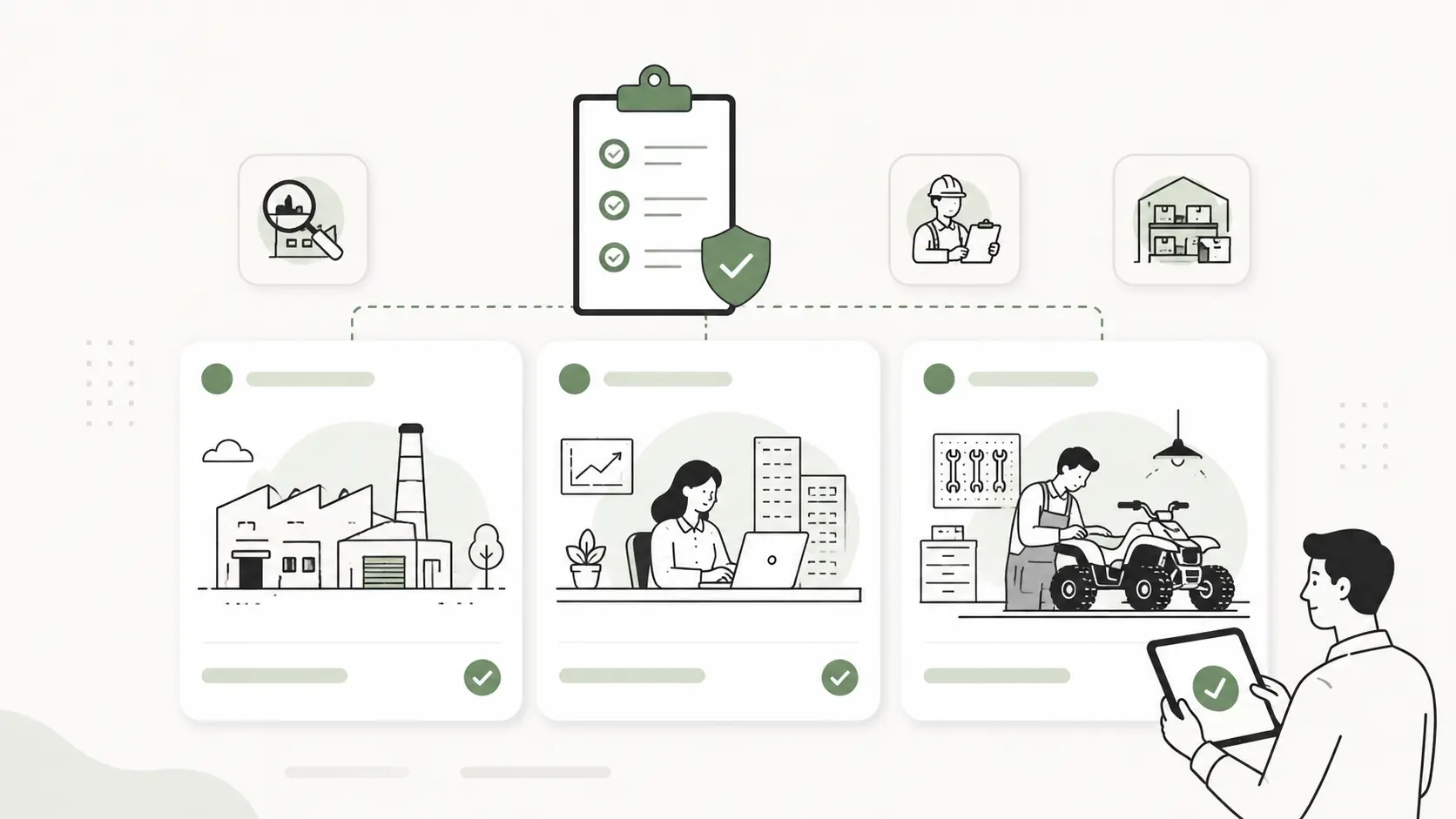
Supplier identity affects model continuity, engineering support, warranty response, and parts availability. A trading company is not automatically a problem; some sourcing partners provide strong QC and communication. The risk appears when a supplier claims factory-level control but cannot provide audit access, technical support, model continuity, or spare parts documentation.
| Supplier Type | What to Verify | Distributor Risk |
|---|---|---|
| Manufacturer | Factory audit, engineering team, production history, parts warehouse, QC records | Usually strongest control over specs, parts, and warranty response |
| Trading company / sourcing partner | Factory access, technical contact, QC process, parts source, warranty accountability | Risk rises if they cannot control the factory or guarantee model continuity |
| Assembler | Component suppliers, assembly process, parts fitment, engineering authority | Specs may change if subassembly suppliers change between production runs |
Verification questions
- Can you provide business registration, export history, and factory address?
- Can we arrange a video audit or third-party factory inspection?
- Can our technical questions be answered by an engineer, not only a salesperson?
- Will the engine, wiring harness, carburetor, body panels, and brake components remain consistent for repeat orders?
3Which ATV Category Fits Your Buyer Segment?
Not every ATV fits every distribution channel. Youth ATVs, entry recreational models, utility ATVs, farm/ranch models, rental fleet units, and electric ATVs create different compliance, parts, and warranty expectations.
| ATV Category | Best-Fit Buyer | Questions to Ask |
|---|---|---|
| Youth ATV | Powersports dealers, e-commerce channels | Age category, speed limitation, warning labels, CPC documentation, dealer safety materials |
| Entry recreational ATV | Dealers serving first-time or budget buyers | Engine reliability, parts supply, assembly quality, warranty terms |
| Utility ATV | Farm/ranch equipment dealers, rural distributors | Payload, towing, rack capacity, ground clearance, suspension, tire specification |
| Rental fleet ATV | Tour operators and rental buyers | Durability, interchangeable parts, maintenance access, fleet repair documentation |
| Electric ATV | Youth, recreational, or low-noise market segments | Battery capacity, charger spec, range, category classification, applicable ATV compliance |
4What Is the MOQ and How Flexible Is Trial Ordering?
MOQ is not just a production number. It affects inventory risk, working capital, dealer testing, and your ability to validate a model before scaling. A low FOB price is not attractive if the supplier forces a full-container order before your dealer network has tested the product.
- Sample order: one or a few units to inspect build quality, documentation, and packaging.
- Mixed-container order: multiple models in one container to test market response.
- Trial batch: a modest first order before seasonal or quarterly purchasing.
- Written production schedule: deposit date, production start, inspection date, cargo-ready date, and shipment booking window.
Procurement CTA
Before committing to a first order, request MOQ, lead time, mixed-container options, sample order terms, and a recommended spare parts kit.
Request wholesale ATV pricing5What Spare Parts Are Available, and for How Many Years?
Spare parts availability is one of the strongest indicators of long-term distributor success with a wholesale ATV supplier. It is a common procurement concern raised by ATV distributors and dealers when suppliers do not have a verified parts program.
Ask for a complete parts catalog with part numbers, fitment information, exploded diagrams, parts MOQ, lead time by category, and the supplier’s recommended first-container parts kit. A parts program should be reviewed before the first container is ordered, not after the first warranty claim arrives.
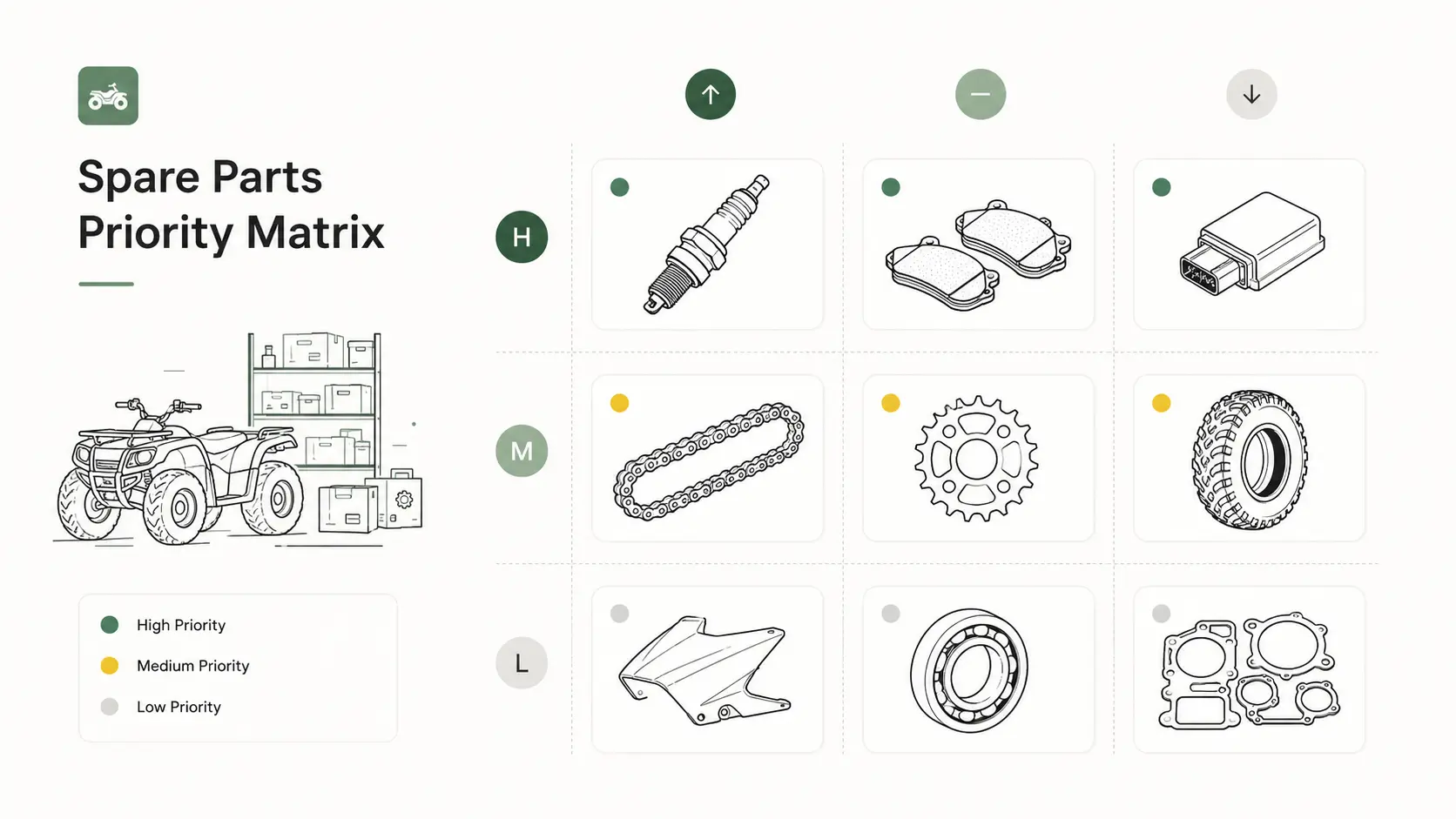
| Part Category | Examples | Stocking Logic |
|---|---|---|
| Engine-related parts | Filters, spark plugs, gasket kits, carburetor parts | Important for dealer service and warranty support |
| Electrical parts | CDI, ignition coil, wiring connectors, regulator | Useful for diagnosis and fast replacement |
| Brake components | Brake pads, calipers, cables, levers | Essential for service and safety-related repairs |
| Body panels and plastics | Fenders, headlight housings, covers | Useful for shipping damage and collision repair |
| Drivetrain and suspension | Chains, sprockets, belts, bearings, tie rods | Important for utility and rental fleet buyers |
6What Warranty Policy Is Offered to Distributors?
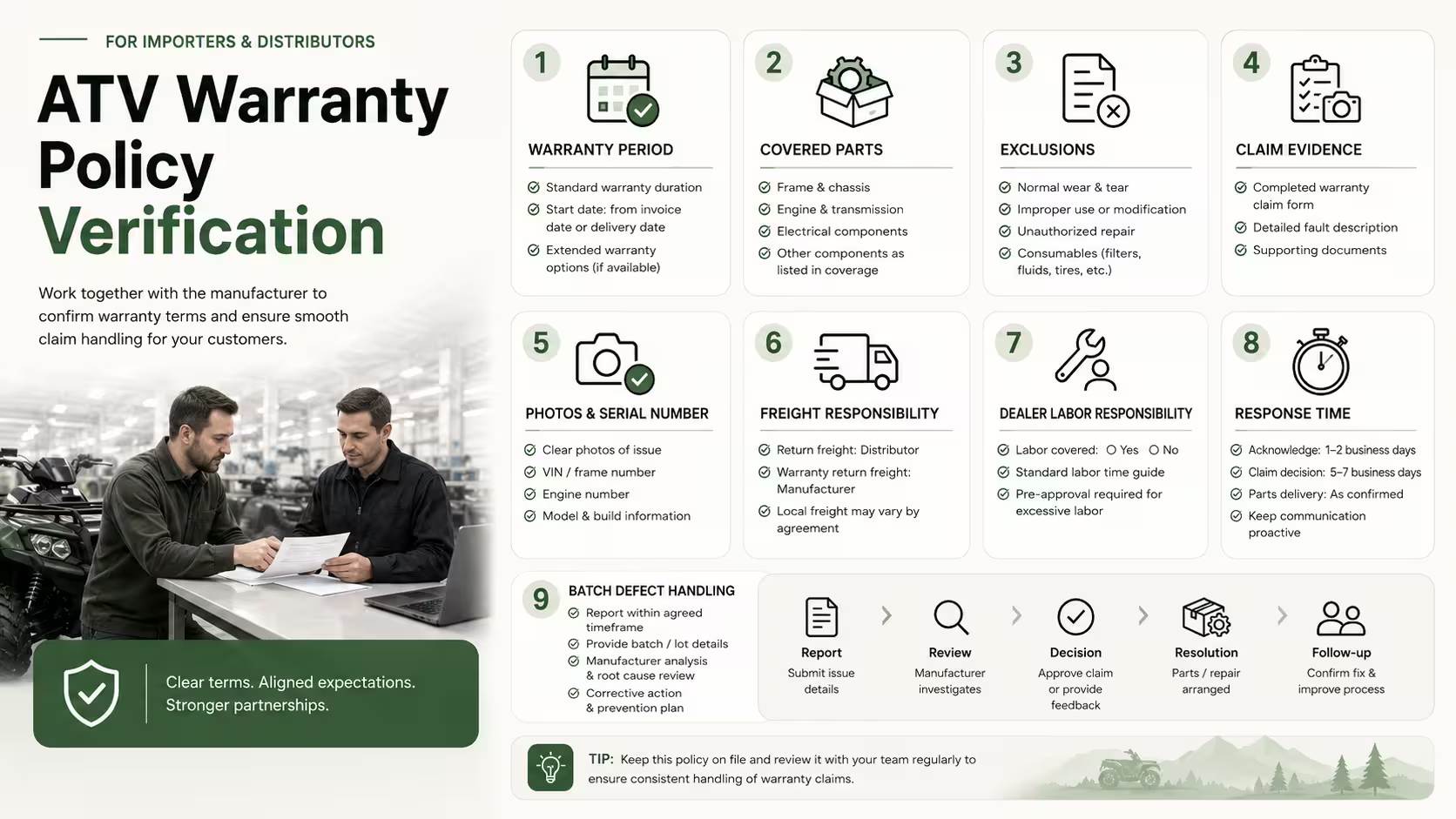
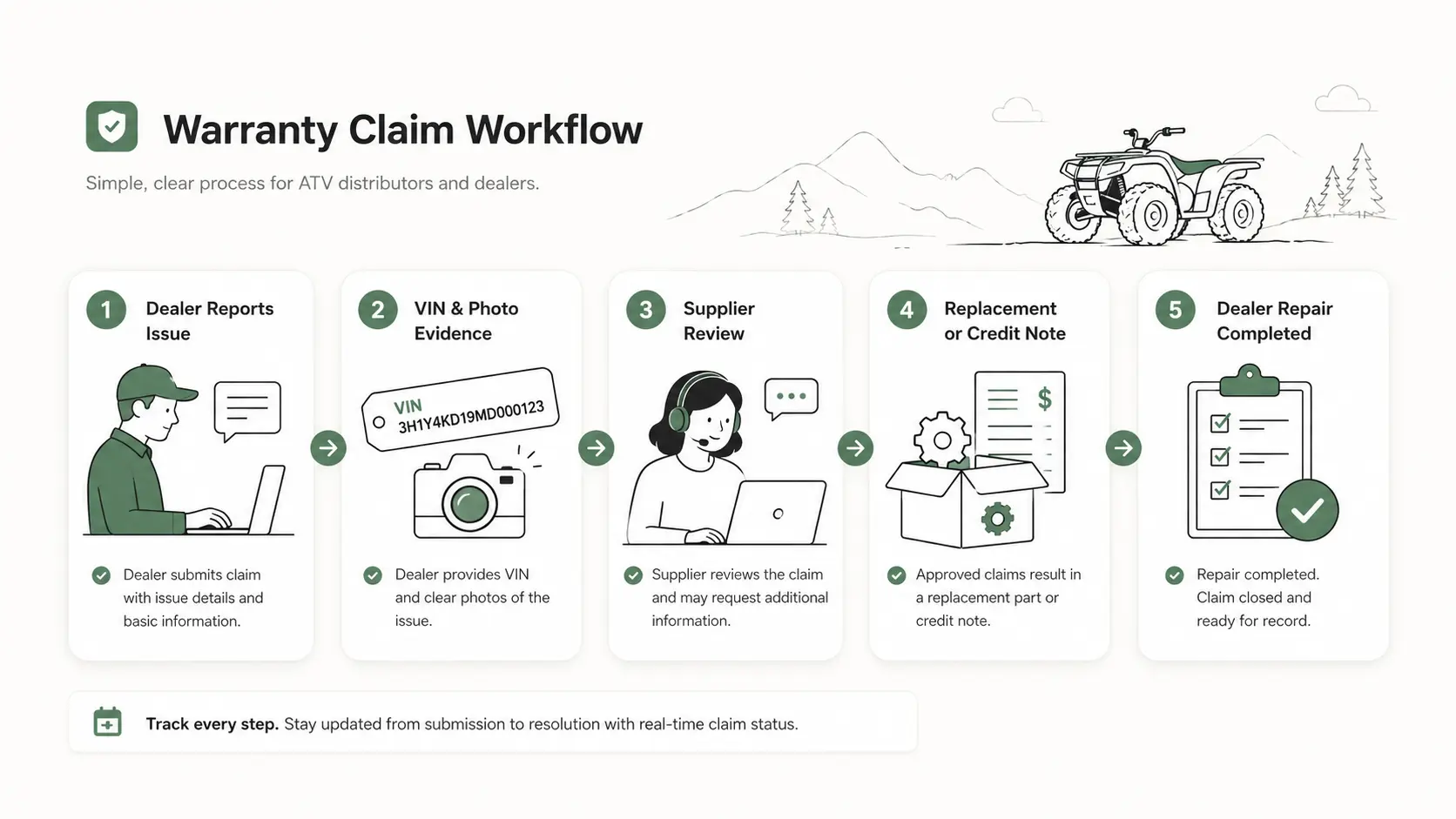
A warranty policy is only useful if it is written. Distributors should not rely on verbal warranty promises or assume that a stated warranty period covers labor, freight, diagnosis time, or batch defects.
- Warranty start date: factory shipment, distributor receipt, or retail sale?
- Covered and excluded components, including normal wear items.
- Labor responsibility for dealer repairs.
- Claim documentation: photos, videos, VIN, sale date, dealer diagnosis.
- Batch defect process when the same issue appears across multiple units.
- Resolution method: replacement parts, credit note, or buyer’s choice.
7What Inspection Process Is Used Before Shipment?
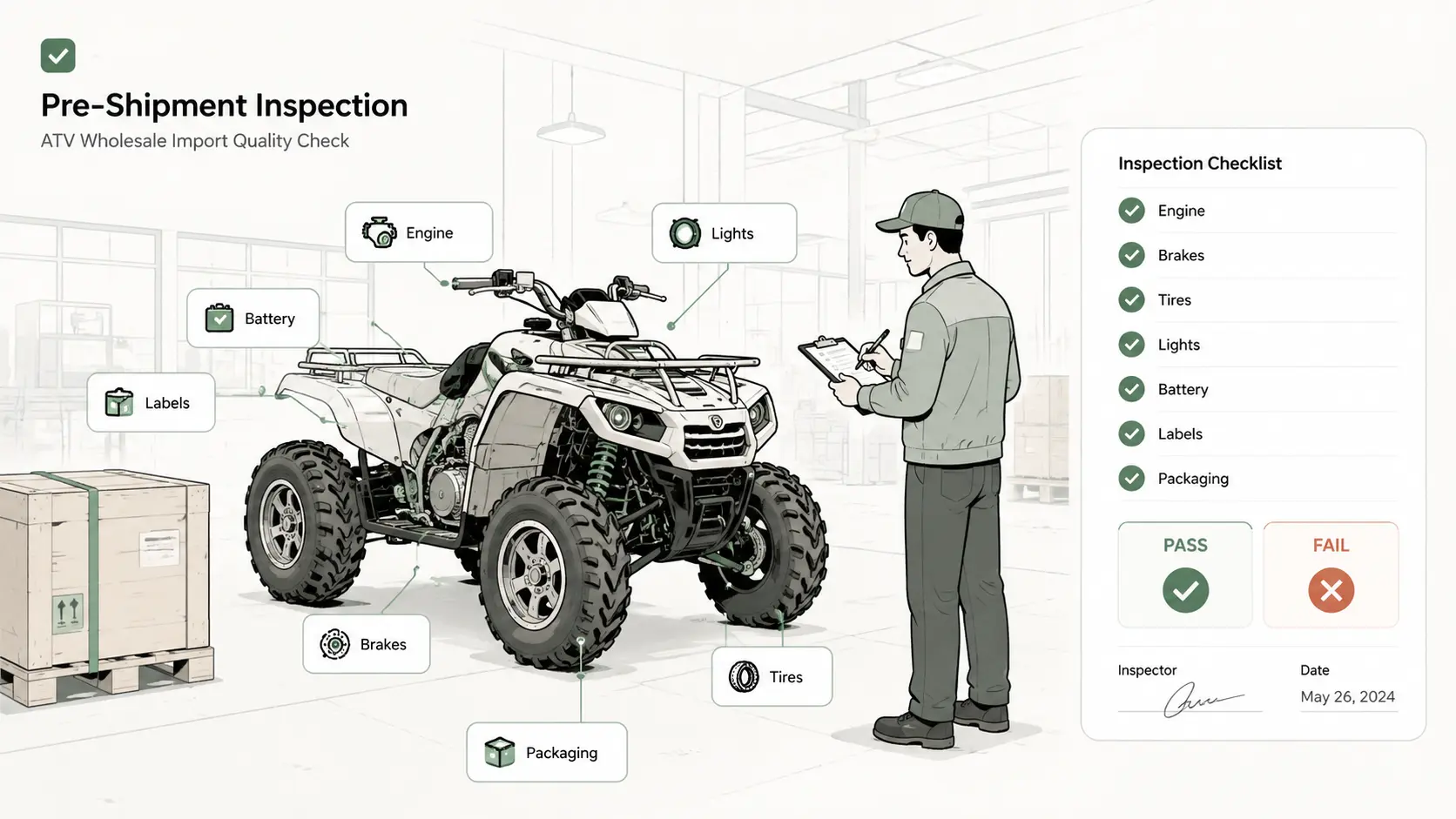
Pre-shipment inspection is the last opportunity to catch quality issues before they become dealer complaints. Do not accept “we inspect everything” as an answer. Ask what is inspected, how it is documented, and whether third-party inspection is permitted.
- Engine start and run test
- Brake function
- Electrical and lighting systems
- Throttle return
- Fluid leaks
- Critical fastener torque
- Written PSI checklist
- VIN / serial list
- PDI form
- Packaging photos
- Third-party inspection access
- Defect escalation procedure
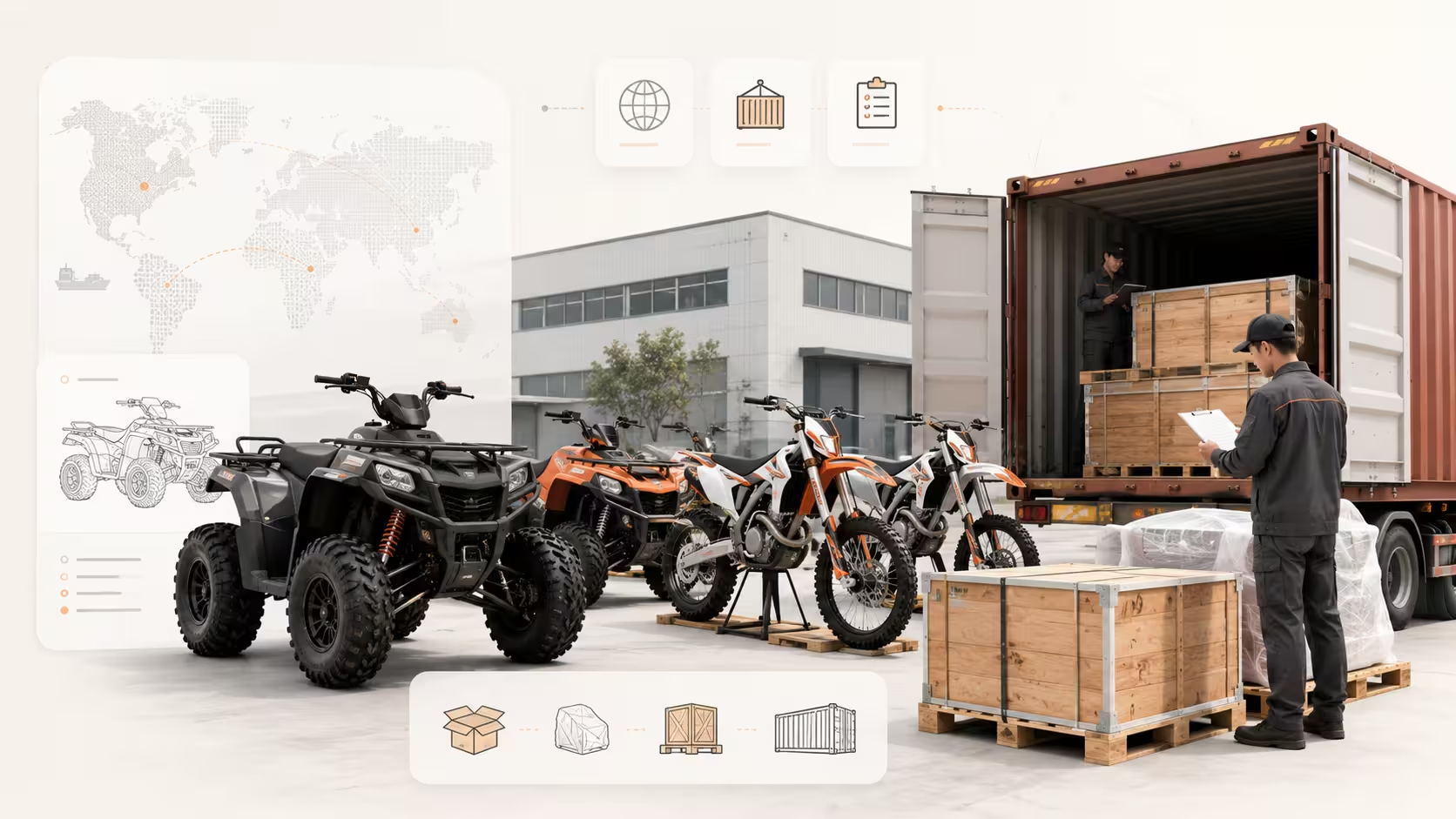
8How Are ATVs Packaged to Reduce Shipping Damage?
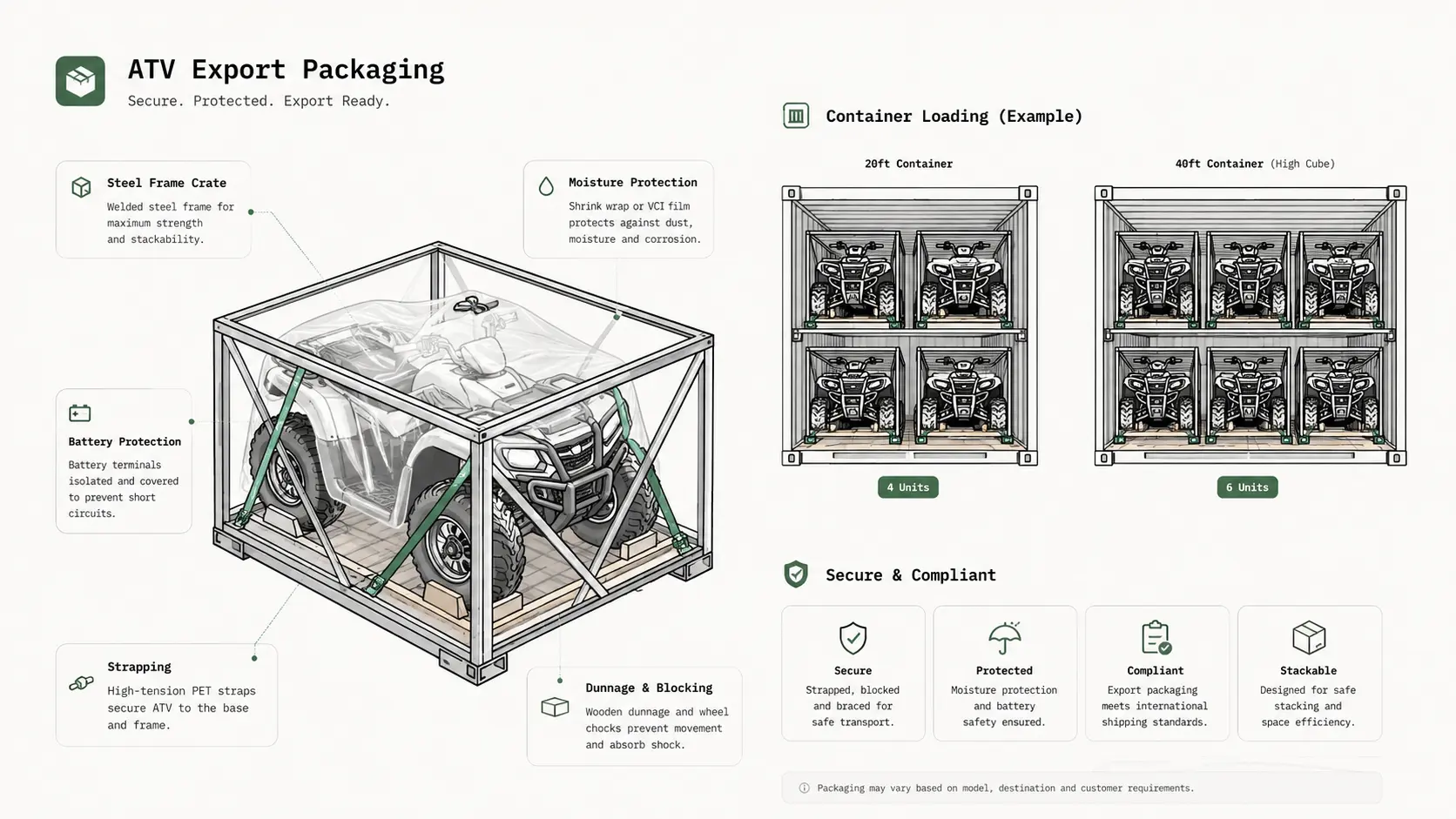
Packaging is not a logistics detail; it is a margin issue. Poor crating, weak moisture protection, unsecured components, or missing hardware can create returns, dealer credits, replacement parts orders, and negative customer experiences.
- Request photos and dimensions of the actual packaging for the model.
- Confirm crate type: steel frame, reinforced wood, or carton-only.
- Ask how batteries are disconnected, stored, or packed.
- Confirm desiccants, exposed-metal protection, and connector protection.
- Ask how loose items such as mirrors, handlebars, tools, and manuals are secured.
- Request a 20-foot and 40-foot container loading plan with strapping method.
9Are Manuals, Labels, VIN Information, and Documentation Provided?
Documentation supports compliance, customs clearance, warranty resolution, dealer training, and end-customer safety. A well-built ATV with poor documentation still creates downstream problems for importers and dealers.
In regulated markets, warning labels and compliance labels may be required and should be verified model by model. For U.S.-market ATVs, CPSC guidance explains labeling and certificate obligations, including CPC or GCC requirements depending on the product type and importer role.
| Document | Why It Matters | When to Request |
|---|---|---|
| Owner’s manual | Safety, maintenance, fluid specs, customer guidance | Before order confirmation |
| Assembly instructions | Correct SKD/CKD assembly and fewer dealer errors | Before shipment |
| PDI checklist | Factory and dealer quality record | Before production and during PSI |
| Labels and warnings | Safety communication and market-specific compliance | Before PSI |
| VIN / serial list | Warranty, recall, customs, and batch traceability | Before container loading |
| CPC / GCC where applicable | CPSC certification context for U.S.-market products | Importer of record / domestic manufacturer responsibility based on applicable rules |
| Parts book | Correct part identification for dealers | Before placing first order |
10Can the Supplier Support Private Label / OEM Branding?
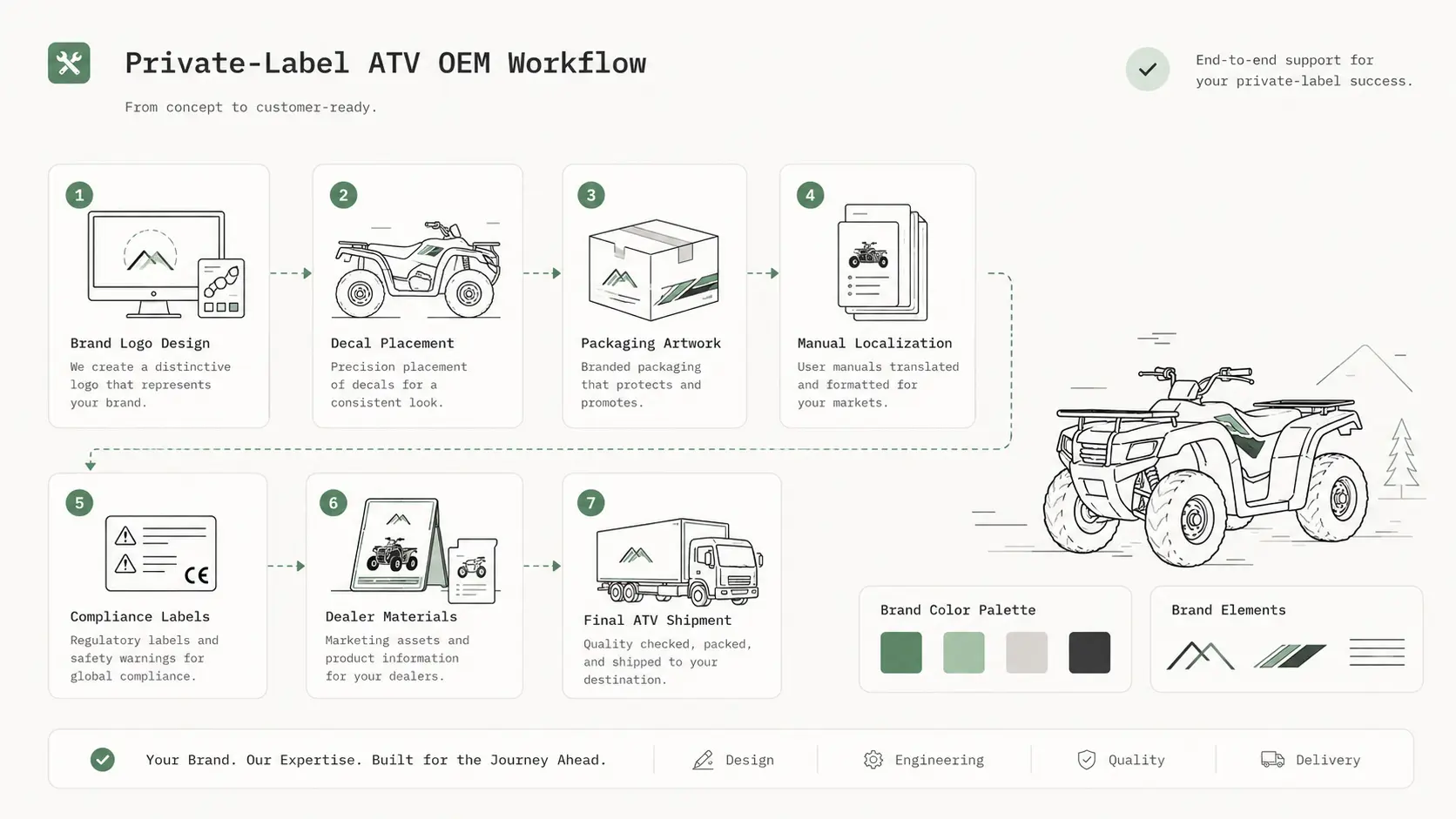
Private-label ATV sourcing is more than placing a logo on a decal. OEM buyers need brand artwork, color options, packaging, localized manuals, correct labels, model continuity, and clear compliance responsibility.
- Logo placement on decals, body panels, and packaging.
- Manuals, warranty documents, and PDI forms under the buyer’s brand.
- Correct entity shown on applicable labels and documentation.
- Model continuity commitments across repeat orders.
- Private-label MOQ, lead time, and artwork approval process.
- Territory or market exclusivity terms, if relevant.
11What Dealer Support Materials Are Available?
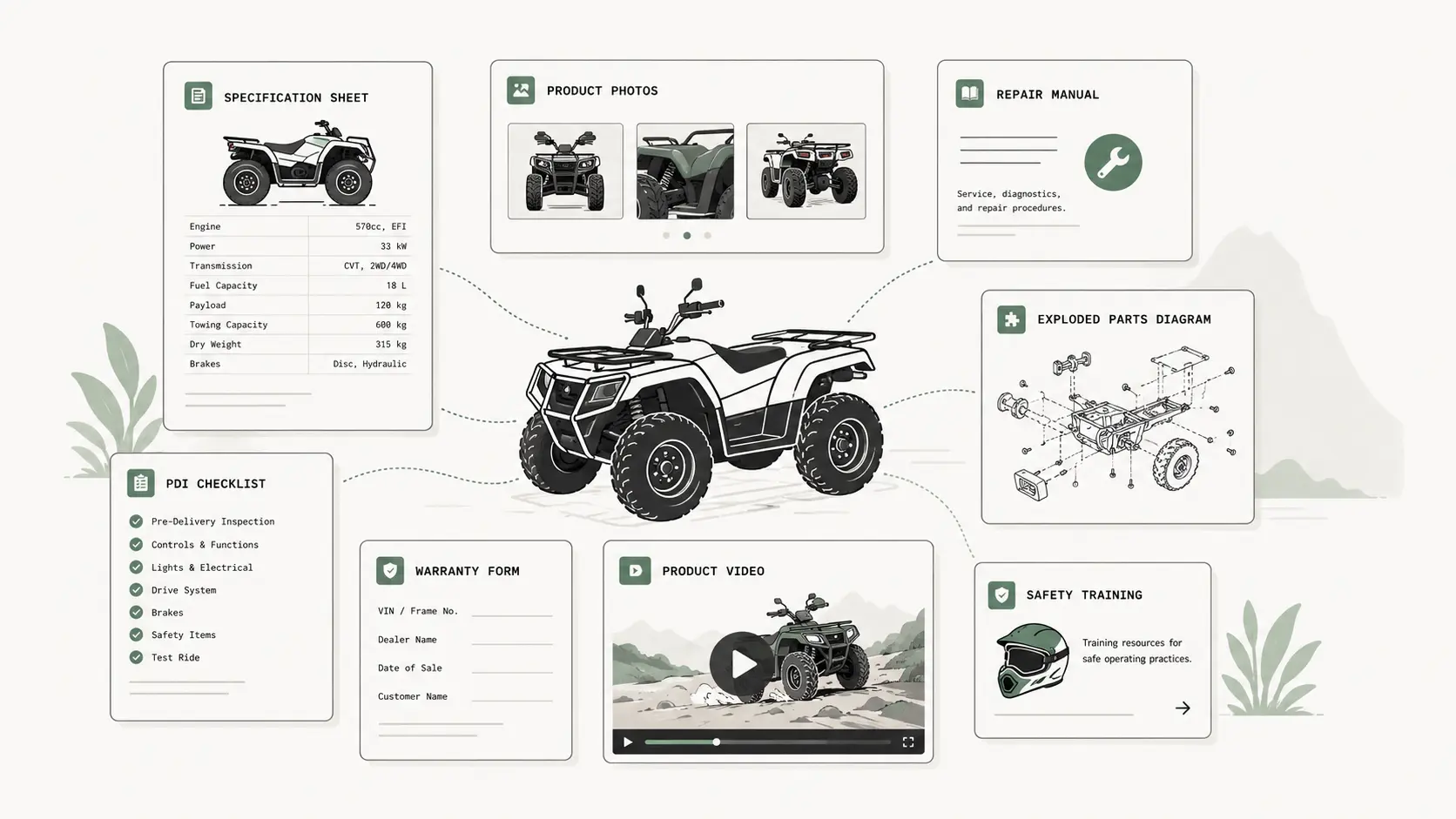
Dealer support materials should be evaluated as part of the product. Dealers need more than a price list; they need the documents and media that allow them to sell, assemble, service, and support the ATV locally.
- Owner’s manual
- Assembly instructions
- Repair / service guide
- Torque reference sheet
- Exploded parts diagrams
- PDI checklist
- Spec sheets
- Product photos
- Product videos
- Feature comparison charts
- Warranty summary
- Safety education references
The ATV Safety Institute provides safety resources and training references that distributors can use when building dealer education programs, especially around youth ATV sales and responsible riding guidance.
12What Is the True Landed Cost Beyond the FOB Unit Price?
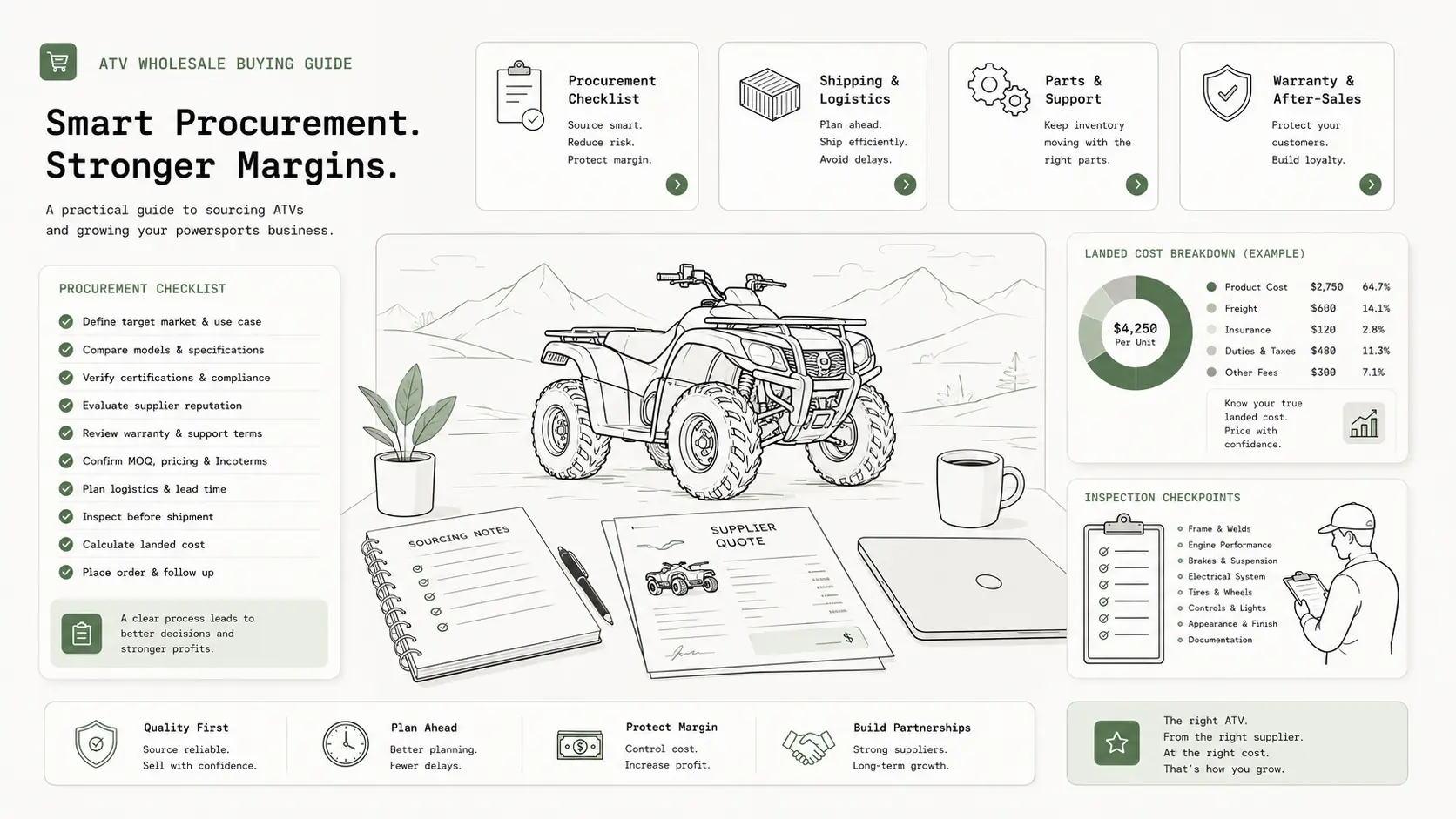
The FOB price is the starting point of an ATV cost model, not the final cost. True landed cost includes freight, insurance, duty, brokerage, port charges, inland transport, assembly, PDI labor, spare parts stock, warranty reserve, launch marketing, financing, and damage allowance.
The ICC Incoterms® 2020 rules are the authoritative reference for Incoterms. Buyers should confirm the correct trade term with a freight forwarder, customs broker, or legal advisor; for container shipments, FCA may sometimes be more appropriate than FOB depending on handover structure.
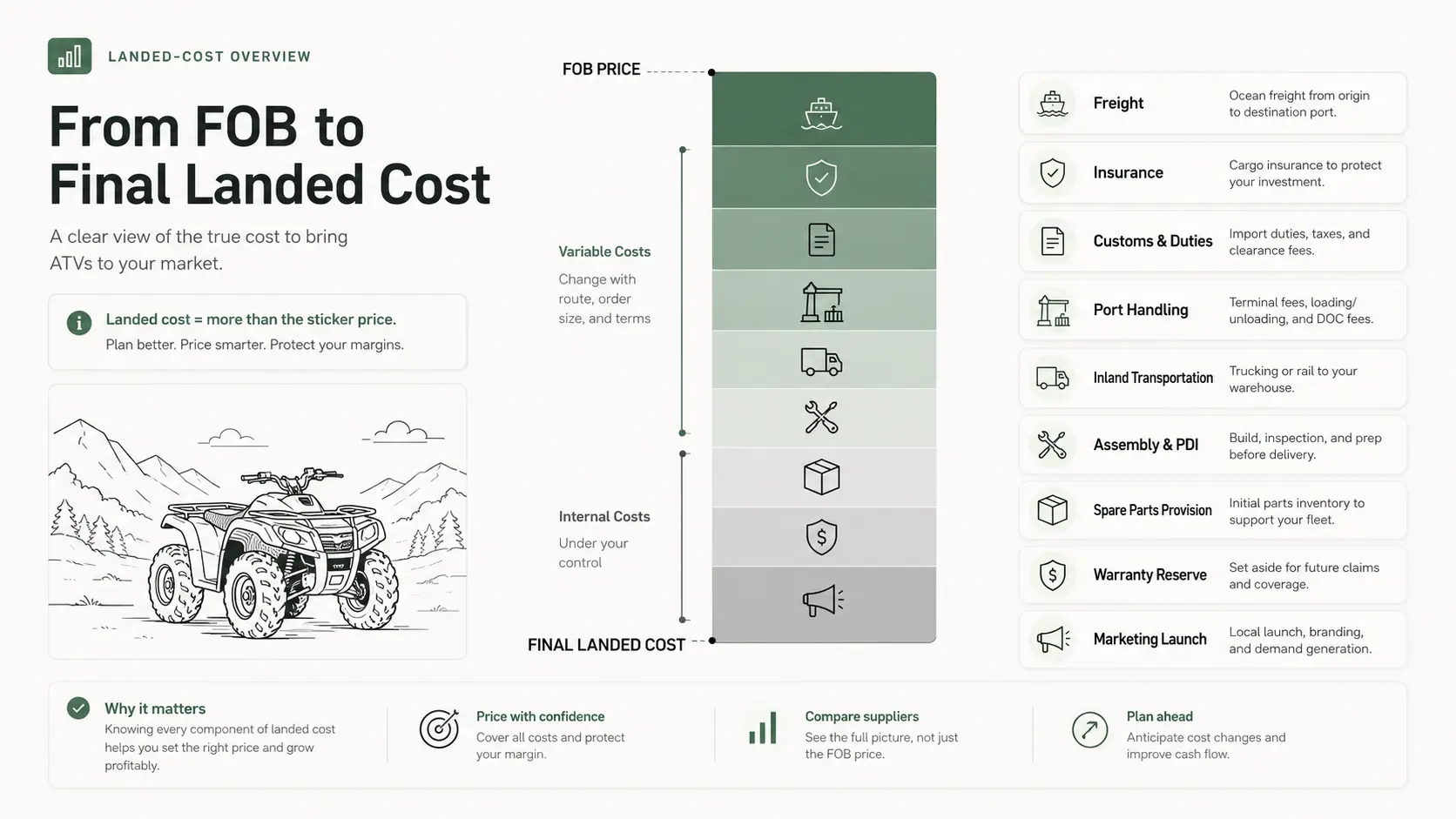
| Cost Item | Usually Included in FOB? | Question to Ask |
|---|---|---|
| FOB unit price | Yes | What is the named FOB port, and which local charges are included before loading? |
| Ocean freight | No | What is the current freight quote from our forwarder? |
| Duty / tariff | No | What HS code and duty rate does our customs broker confirm? |
| Assembly and PDI labor | No | How much dealer labor is required after arrival? |
| Spare parts stock | No | What first-container parts kit should be stocked? |
| Warranty reserve | No | Which repair costs remain with the distributor? |
| Marketing and dealer launch | No | Which sales materials does the supplier provide? |
Red Flags When Choosing a Wholesale ATV Supplier
- The supplier only talks about low price and avoids documentation questions.
- No model-specific parts catalog or exploded diagrams are available.
- Warranty terms are verbal, vague, or limited to “we will help.”
- The supplier cannot explain market-specific compliance responsibilities.
- No factory audit, video audit, or third-party inspection access is allowed.
- Model specifications change between orders without advance notice.
- No written PSI checklist or PDI documentation is available.
- Packaging photos are unavailable or do not match the actual model.
- You cannot identify a dedicated technical or after-sales contact.
- The supplier claims “certified for all markets” without model-specific proof.
- Youth ATV age categories, labels, or manuals cannot be clearly explained.
- FOB pricing excludes key items but the supplier cannot define what is included.
Supplier Evaluation Scorecard
| Evaluation Criteria | Weight | Key Question | Score 1–5 |
|---|---|---|---|
| Compliance documentation | 20% | Can the supplier provide model-specific documents for the target market? | __ / 5 |
| Factory verification | 10% | Can factory identity, production capacity, and audit access be verified? | __ / 5 |
| Spare parts support | 15% | Is there a catalog, exploded diagram, lead time, and stocking plan? | __ / 5 |
| Warranty policy | 15% | Are warranty coverage, exclusions, labor, claims, and response time written? | __ / 5 |
| Inspection process | 10% | Is PSI documented and is third-party inspection allowed? | __ / 5 |
| Packaging quality | 10% | Are crate specs, moisture protection, and loading plans documented? | __ / 5 |
| Dealer support | 10% | Are manuals, service guides, photos, PDI forms, and warranty documents provided? | __ / 5 |
| Landed cost transparency | 10% | Can the buyer model costs beyond FOB before placing the order? | __ / 5 |
FAQ
What should ATV distributors check before placing a bulk order?
Distributors should check compliance documents, supplier identity, model specifications, MOQ, lead time, spare parts availability, warranty terms, PSI process, packaging, manuals, labels, VIN traceability, dealer support materials, and true landed cost. A good supplier should answer these questions with documents, not only verbal assurances.
Is the cheapest wholesale ATV supplier the best option?
Usually, the cheapest quotation is only useful after you understand what is included. A low FOB price may exclude parts support, strong packaging, documentation, warranty coverage, or dealer materials. Compare suppliers by total business risk, not unit price alone.
How many spare parts should a distributor stock?
There is no universal number. Stocking should depend on model type, order quantity, dealer network size, local repair capability, and supplier lead time. At minimum, ask for a recommended first-container parts kit and prioritize engine-related parts, brake components, electrical items, body panels, and wear parts.
Can I import private-label ATVs?
Yes, but private-label ATV sourcing requires more than logos. Buyers should confirm brand artwork, manuals, labels, packaging, warranty documents, model continuity, compliance responsibility, and market exclusivity terms. For regulated markets, verify labeling and certificate obligations with a qualified advisor.
What is the difference between FOB price and landed cost?
FOB price is the supplier’s price up to the named export port under the agreed Incoterm. Landed cost includes additional expenses such as freight, insurance, duty, brokerage, port fees, inland freight, assembly, spare parts stock, warranty reserve, marketing, and financing.
How can distributors reduce ATV warranty claims?
Start before shipment. Choose a supplier with documented QC, require PSI, confirm packaging, request PDI forms, stock parts, train dealers, and negotiate written warranty terms. Many warranty disputes are created by missing documentation, poor assembly guidance, weak packaging, or unclear labor responsibility.
Conclusion: Choose the Supplier That Protects Your Dealer Network
A strong ATV wholesale supplier is not simply the factory with the lowest FOB price. The right partner helps you verify compliance, reduce shipping damage, support dealers, supply parts, handle warranty claims, maintain model continuity, and understand the true cost of the program before you commit to a container.
Before placing a bulk ATV order, request the model list, MOQ, lead time, spare parts catalog, exploded diagrams, written warranty terms, packaging photos, available compliance documents for your target market, and OEM/private-label options if needed.
Request ATV wholesale documents and pricing