

How to Choose a Reliable ATV Manufacturer for Wholesale
Use this checklist-driven guide to screen ATV factories, verify compliance capability, compare supplier types, and reduce risk before placing a wholesale order.
Executive Summary
Choosing a reliable ATV manufacturer for wholesale is not the same as choosing an ATV model for retail buyers. Importers, distributors, dealers, rental operators, and OEM buyers need to verify the supplier behind the product: factory identity, production stability, compliance documentation, spare parts support, warranty process, quality control, packaging standards, and after-sales capability.
Before paying a deposit, buyers should ask: Is this supplier a real manufacturer, trading company, or assembler? Can the factory support a third-party audit? Does it control engineering, specifications, production, and parts? Can it provide model-specific compliance documents for the target market? Does it maintain a spare parts warehouse and parts catalog? Will the same model remain available for repeat orders?
This guide is built for manufacturer screening and supplier verification. It is designed to help wholesale buyers reduce business risk, compare suppliers more clearly, and request the right documents before committing to a long-term ATV supply relationship.
Introduction
For wholesale ATV buyers, the lowest FOB price is rarely the full cost of a supplier relationship. A cheap ATV bulk order can become expensive if the supplier cannot provide compliance documents, spare parts, warranty support, stable model specifications, packaging evidence, or after-sales communication.
ATVs are also a safety-sensitive product category. The U.S. Consumer Product Safety Commission provides guidance through the CPSC OHV & ATV Safety Information Center and CPSC Business Guidance for ATVs. For U.S.-bound ATVs, buyers should verify requirements related to the applicable ATV standard, ATV Action Plan, labels, certificates, and model-specific documentation before importing.
Why this matters: a supplier that can only discuss price, color, and shipping date has not yet proven that it is reliable enough for long-term wholesale cooperation.
Why Choosing the Right ATV Manufacturer Matters for Wholesale Buyers
A wholesale ATV supplier affects more than purchase price. The supplier affects customs preparation, dealer confidence, after-sales workload, repeat-order consistency, and long-term brand reputation. A good-looking sample does not prove that the factory can support repeat production, replacement parts, compliance documents, warranty claims, or private-label programs.
1Verify Whether the Supplier Is a Real Manufacturer
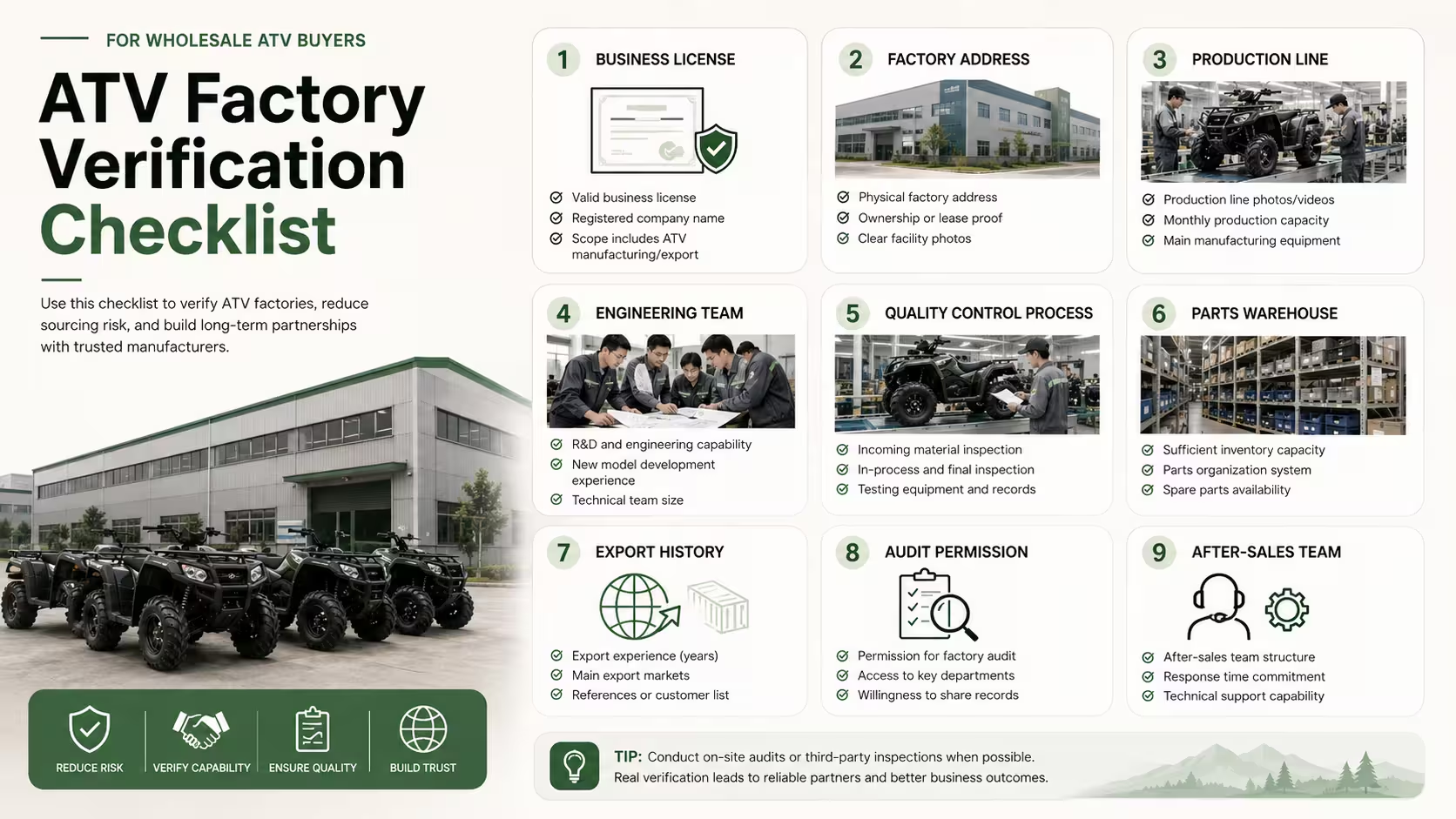
The first step in choosing a reliable ATV manufacturer for wholesale is confirming who controls the product. A supplier may describe itself as a “factory,” but buyers should verify whether it is actually a real ATV manufacturer, a trading company, an assembler, or a sales office representing several factories.
| Supplier Type | What They Usually Control | What to Verify | Main Distributor Risk |
|---|---|---|---|
| Real ATV manufacturer | Production line, engineering specifications, assembly process, QC system, parts sourcing, model updates, after-sales coordination | Business license, factory address, production line photos/videos, audit permission, engineering team, QC process, parts warehouse, export history | Still requires verification, but usually has stronger control over specifications, parts, and repeat orders |
| Trading company | Sales communication, supplier sourcing, quotation, export coordination | Actual factory name, source authorization, audit access, warranty responsibility, parts source | Limited control over engineering, production changes, spare parts, and warranty escalation |
| Assembler | Final assembly, packaging, limited QC, some local sourcing | Which components are in-house vs outsourced, assembly capacity, incoming inspection, traceability, parts availability | May not control core components, model changes, or long-term parts supply |
| Sales office / export agent | Buyer communication and order handling | Legal relationship with factory, responsibility for documents, payment recipient, and after-sales process | Responsibility becomes unclear if defects, parts shortages, or compliance questions arise |
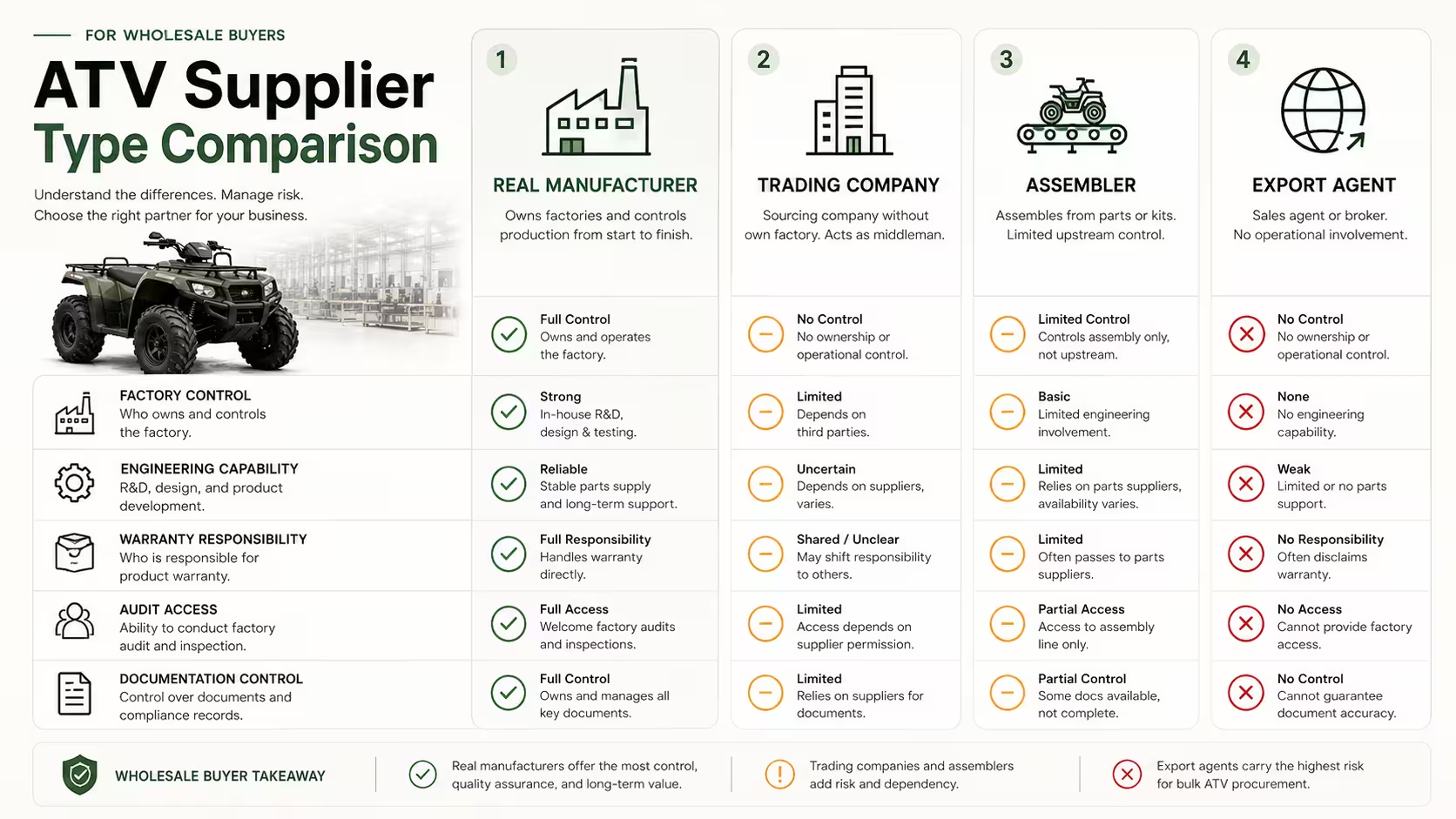
A trading company is not automatically unreliable, and a factory is not automatically reliable. The key question is whether the supplier can prove control, responsibility, and continuity.
What to request before treating the supplier as a manufacturer
- Business license showing company name and registered scope
- Factory address and production site photos
- Production line videos with current date or buyer-specific reference
- Factory organization chart and engineering contact
- Export history by market and current model list
- Parts warehouse photos, parts catalog, and exploded diagrams
- Warranty and after-sales team contact details
- Permission for buyer audit or third-party factory audit
Factory audit questions
- Does the factory have dedicated ATV assembly lines?
- Which models are currently in production?
- Which components are produced in-house and which are sourced externally?
- Are incoming inspection, torque checks, brake checks, electrical checks, and engine start tests documented?
- Does the supplier maintain batch records and labeled after-sales parts storage?
- Can the factory support OEM decals, manuals, packaging, and labels without changing core specifications unexpectedly?
2Check ATV Compliance and Documentation Capability
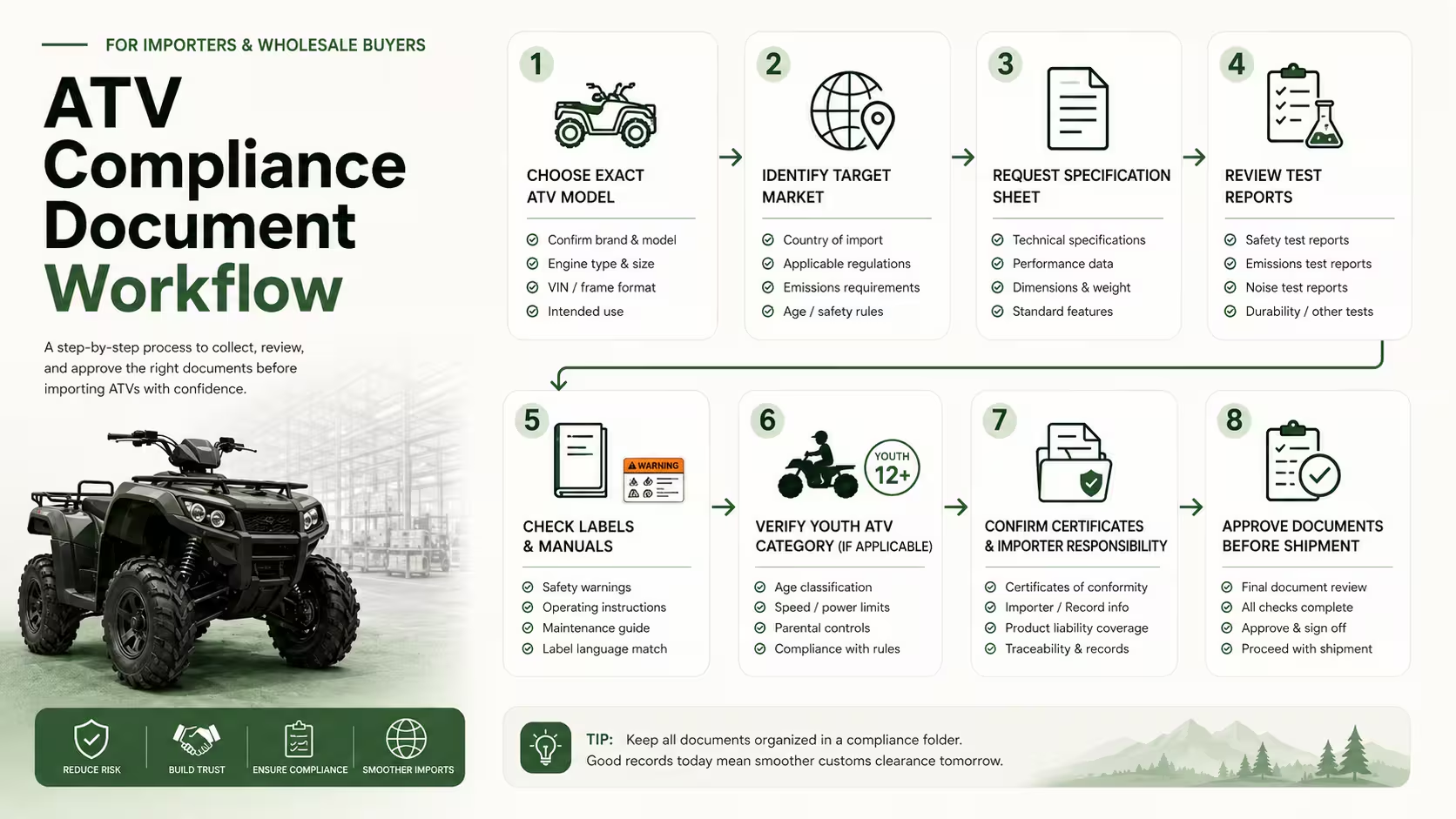
Compliance should be checked before price negotiation becomes serious. A supplier that cannot explain documentation may create risk for the importer, distributor, dealer network, and end customers. Buyers should avoid broad claims such as “certified for all markets” and instead request documents for the exact model, exact market, and exact buyer role.
For U.S.-bound ATVs, the CPSC Business Guidance for ATVs explains that four-wheel ATVs must comply with applicable ANSI/SVIA provisions, be subject to an active ATV Action Plan on file with CPSC and approved by the Commission, and bear required labels. Buyers can also review the CPSC ATV Action Plan List when screening suppliers for the U.S. market.
Compliance disclaimer: Compliance requirements vary by country, ATV category, age group, engine type, and intended use. U.S. references such as CPSC, ANSI/SVIA, ATV Action Plan, CPC, and GCC are provided for U.S.-market context only. This article is not legal advice. Importers should verify model-specific requirements with the relevant authority, accredited testing laboratory, customs broker, or compliance advisor before importing.
| Document | Why It Matters | Who Provides It | When to Request |
|---|---|---|---|
| Model specification sheet | Confirms engine type, dimensions, category, intended use, safety features, and key components | Manufacturer | Before quotation comparison |
| Test report, where applicable | Supports model-specific compliance review | Manufacturer / accredited laboratory | Before deposit |
| ATV Action Plan evidence for U.S.-bound ATVs | Helps verify whether the ATV is covered by an approved Action Plan where required | Manufacturer, distributor, or importer depending on structure | Before deposit and before shipment |
| CPC or GCC, where applicable | Products subject to a CPSC-enforced rule require a certificate of compliance depending on product category | Importer of record or domestic manufacturer, based on applicable rules | Before import |
| Owner’s manual and warning labels | Support safe use, dealer handover, and market-specific labeling review | Manufacturer / compliance advisor | Before sample approval |
| Youth ATV age category documentation | Confirms correct category and intended rider age group | Manufacturer / compliance advisor | Before ordering youth models |
| Packaging label artwork | Helps prevent incorrect private-label or market-label production | Manufacturer / buyer | Before mass production |
Youth ATV and electric ATV caution
The CPSC ATV FAQ lists youth ATV categories and explains that electric or battery-powered ATVs that meet the statutory ATV definition must meet ATV requirements. The CPSC Guidance for Categorizing Youth ATVs also warns that some children’s electric four-wheeled products that meet the ATV definition have been incorrectly classified as ride-on toys.
A better procurement question is: For this exact model, intended age group, motor type, speed, design, and target market, what compliance category applies, and what documents support that classification?
3Evaluate Product Range and Model Fit
After verifying factory identity and compliance capability, buyers should evaluate whether the manufacturer’s product range matches the buyer’s business model. This section is not about choosing the most exciting ATV model. It is about choosing models the supplier can produce consistently, document properly, support with spare parts, and continue offering across repeat orders.
| Buyer Type | Model Fit Questions to Ask |
|---|---|
| Importer | Which models have export history, compliance documents, packaging records, and stable production? |
| Regional distributor | Which models can support repeat orders, spare parts inventory, warranty handling, and dealer channels? |
| Powersports dealer | Which models have stable specifications, available parts diagrams, manuals, and PDI support? |
| Farm/ranch dealer | Which utility models have practical specifications, serviceable components, and parts availability? |
| Rental fleet buyer | Which models are easiest to inspect, repair, standardize, and keep in service? |
| OEM/private-label buyer | Which models can support brand requirements without unstable specification changes? |
A large catalog does not always mean a stronger manufacturer. For wholesale buyers, a smaller range of stable models may be more valuable than a long list of models that change frequently. Before choosing a model, ask whether it will remain available for repeat orders, whether parts are shared with other models, and whether the supplier will notify buyers before changing components.
4Review Spare Parts Support Before Ordering
Spare parts support should be checked before the first wholesale order, not after customers begin requesting repairs. For ATV importers and distributors, parts availability affects dealer confidence, warranty cost, repeat sales, and long-term brand reputation. A supplier that can ship complete units but cannot support parts is not a reliable ATV manufacturer for wholesale.
A strong manufacturer should be able to provide a spare parts catalog, exploded parts diagrams, parts codes or SKUs, a recommended first-order parts kit, a fast-wear parts list, parts MOQ policy, packing method, ordering process, after-sales contact, and a clear process for discontinued or updated parts.
| Area | What to Ask | Strong Supplier Answer | Red Flag |
|---|---|---|---|
| Parts catalog | Do you have a parts catalog for this exact model? | Model-specific catalog with part names, codes, and diagrams | Only generic photos or “we will identify later” |
| Exploded diagrams | Can you provide exploded parts diagrams? | Diagrams for major systems such as frame, brakes, electrical, engine/motor, plastics, and controls | No diagrams available |
| Parts codes | Are parts codes stable across repeat orders? | Uses consistent part codes and notifies buyers when parts change | Changes components without documentation |
| Fast-wear parts | Which parts should be stocked first? | Provides a practical first-order parts list for the exact model | Says parts are “not needed” without explanation |
| Parts warehouse | Do you keep parts in stock? | Shows parts storage, inventory process, and after-sales contact | No visible parts storage or unclear responsibility |
| Model updates | What happens when components change? | Provides change notice, updated diagrams, and compatibility notes | Changes components without buyer notice |
For the first wholesale shipment, ask the manufacturer to recommend a starter parts kit based on the model, target market, dealer network, and expected service environment. Typical categories to discuss include brake-related parts, filters, cables, electrical components, tires or tubes where applicable, suspension wear items, plastics, lights, switches, and small hardware.
Parts-support request
Before confirming the first order, request the model-specific spare parts catalog, exploded diagrams, and recommended first-order parts kit.
Request ATV spare parts support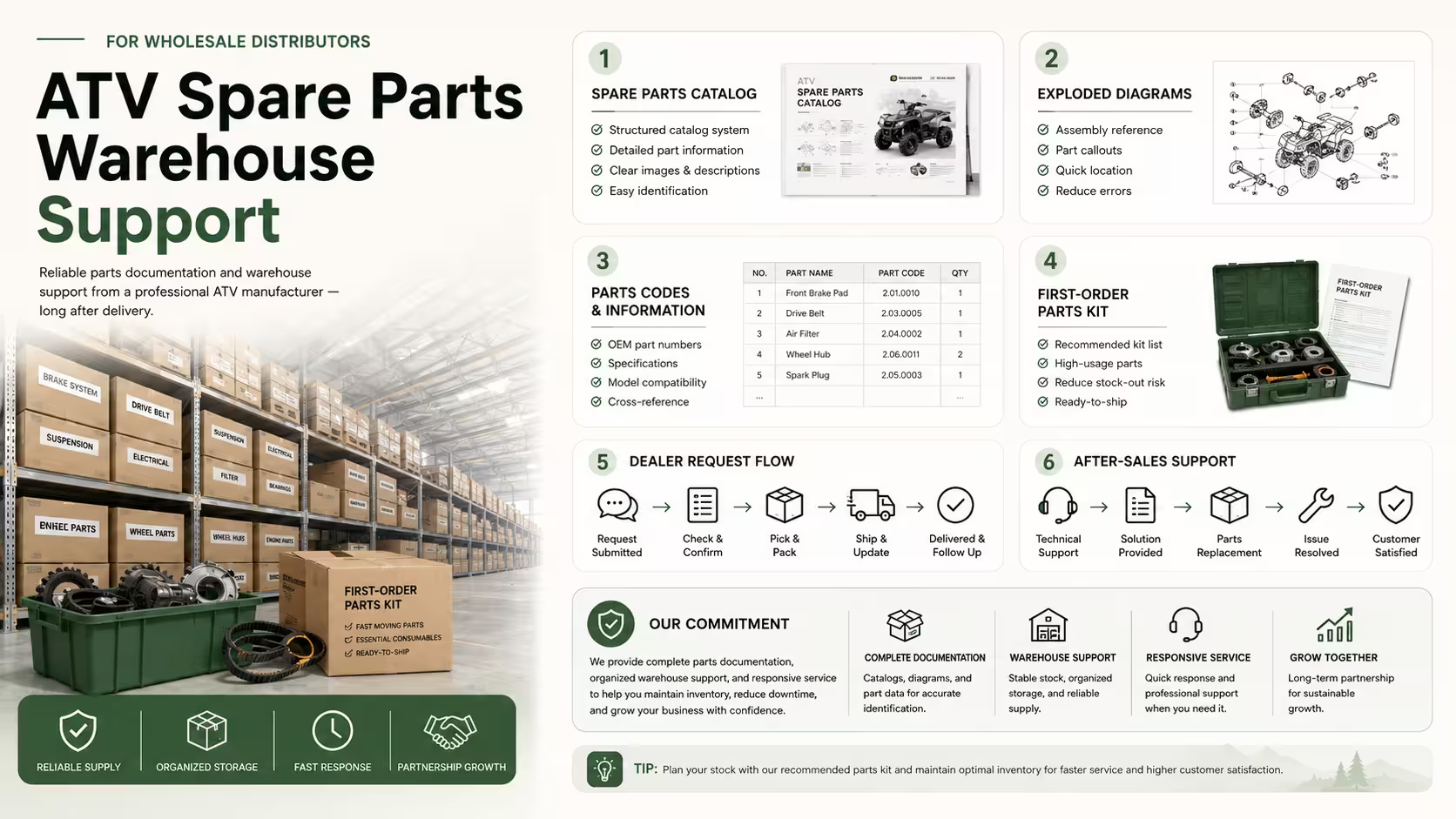
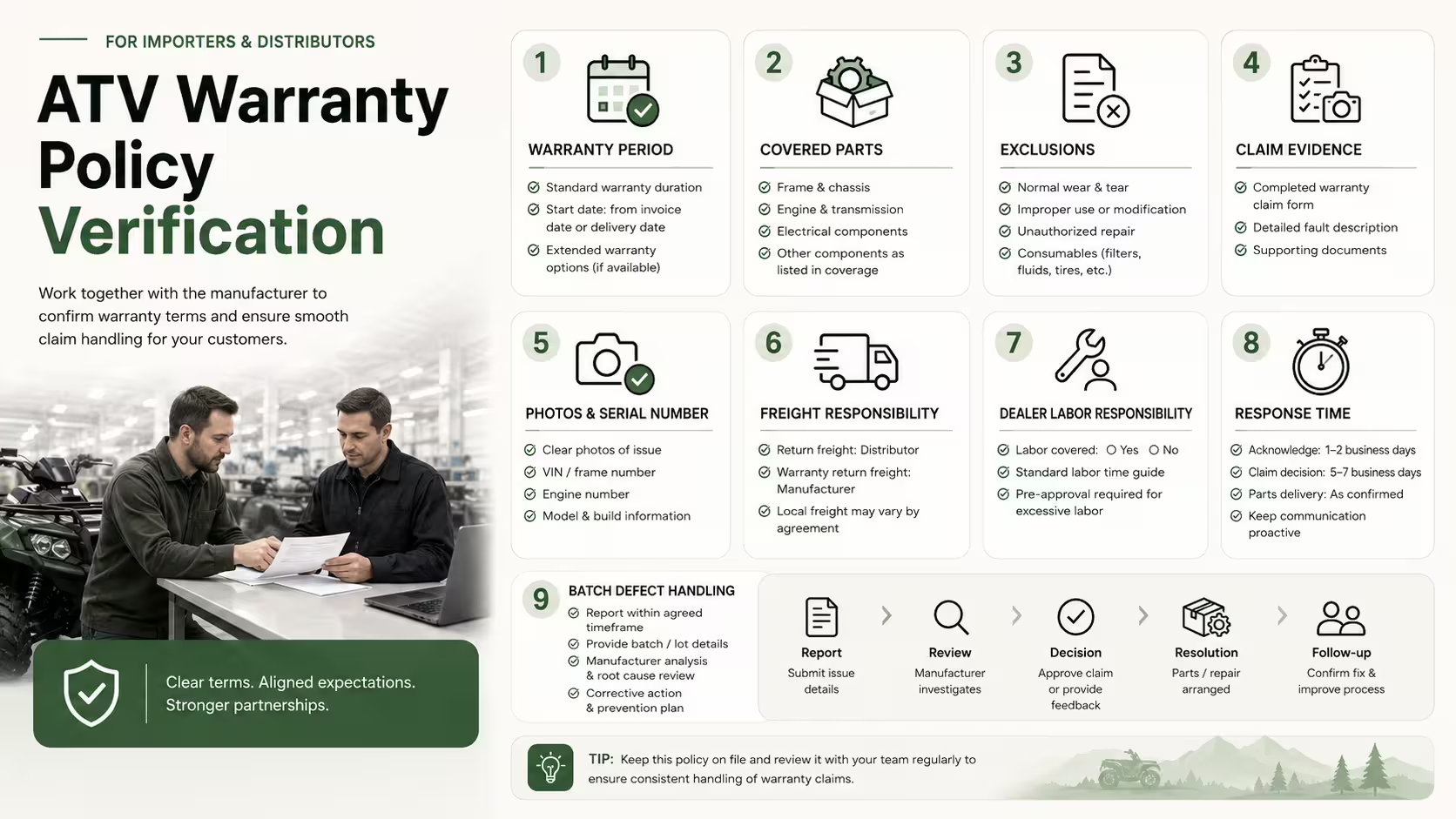
5Demand a Written Warranty Policy
A reliable ATV manufacturer should provide a written warranty policy before order confirmation. For wholesale buyers, warranty is not only a customer-service issue. It affects dealer relationships, cash flow, parts inventory, freight responsibility, labor expectations, and brand reputation.
Ask the supplier to provide written terms covering the warranty period, parts coverage, exclusions, claim submission process, required photos or videos, serial numbers, responsibility for replacement parts, freight responsibility, dealer labor position, response time, and batch defect handling. If the buyer sells through dealers, the warranty policy should also be clear enough for dealer use.
A supplier with a serious quality system should be able to explain what happens if multiple units from the same shipment show the same issue, how claims are grouped and reviewed, whether production records can be checked, and how corrective action is communicated.
6Understand MOQ, Sample Orders, and Trial Containers
MOQ should be evaluated as part of supplier risk, not only as a price negotiation point. A reliable ATV manufacturer for wholesale should be able to explain MOQ by model, color, configuration, packaging, and OEM/private-label requirements. Buyers should also understand whether the supplier allows samples, trial batches, mixed-container orders, or phased purchasing.
| Order Type | Best Use Case | Buyer Benefit | Risk to Watch |
|---|---|---|---|
| Sample unit | Initial evaluation of product quality, assembly, packaging, and documentation | Allows technical review before larger commitment | A sample may not prove mass-production consistency |
| Trial batch | Market testing with limited exposure | Helps buyer test demand, dealer response, and after-sales process | Unit cost may be higher than larger orders |
| Mixed-container order | Testing several models or configurations | Reduces overstock risk and compares model fit | Can complicate parts planning and documentation |
| Standard container order | Repeat purchase after supplier verification | Improves planning once model and supplier are validated | Risky if placed before compliance, parts, and warranty review |
| OEM/private-label order | Buyer-branded program | Supports brand differentiation and dealer strategy | Requires strict control of labels, manuals, packaging, and documents |
During a sample or trial order, evaluate more than the product. Evaluate quotation clarity, specification consistency, document quality, packaging quality, communication speed, spare parts support, inspection cooperation, and warranty response. If the supplier performs poorly during the trial stage, larger orders will usually increase the problem rather than solve it.
7Inspect Quality Control and Pre-Shipment Process
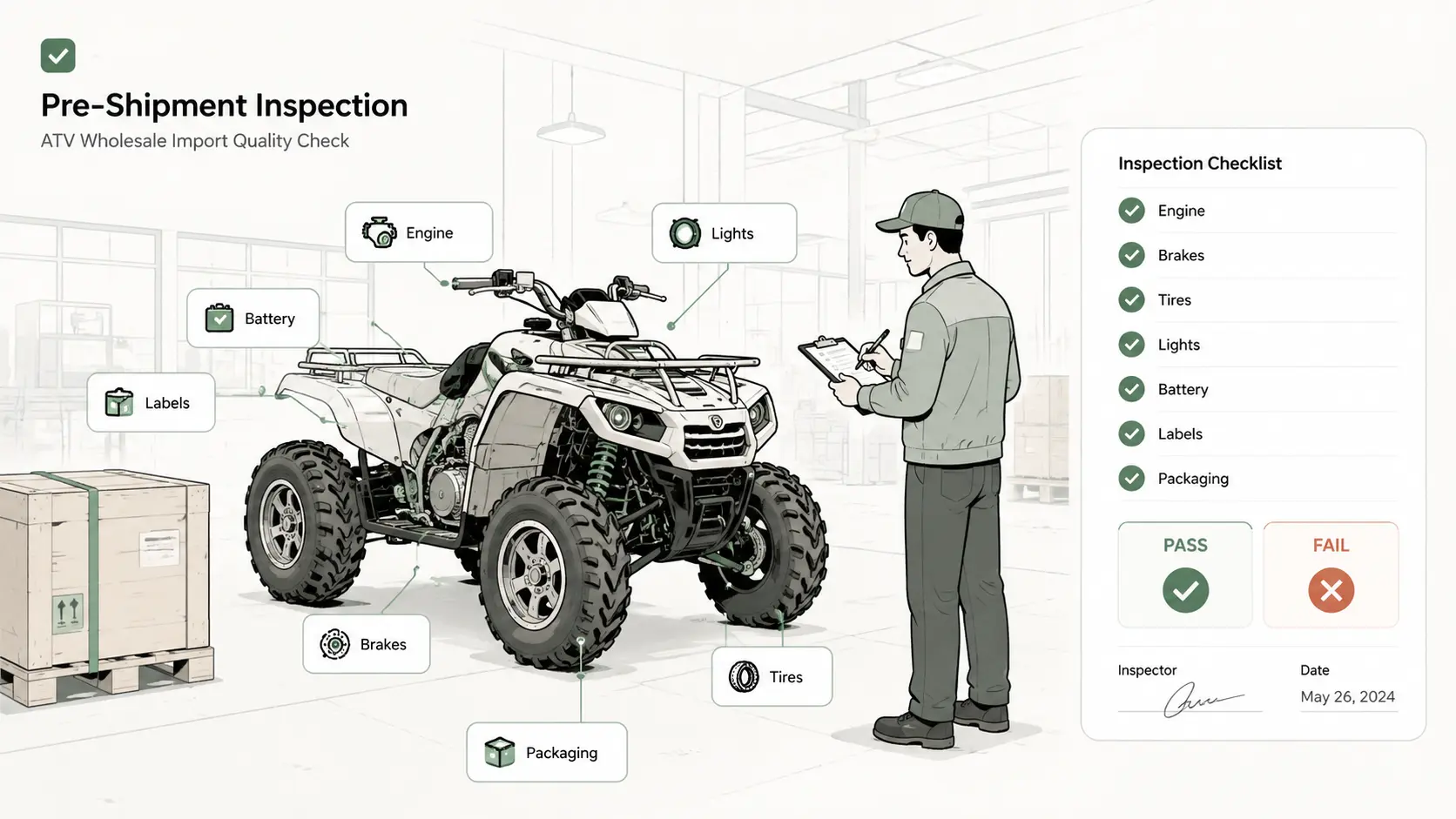
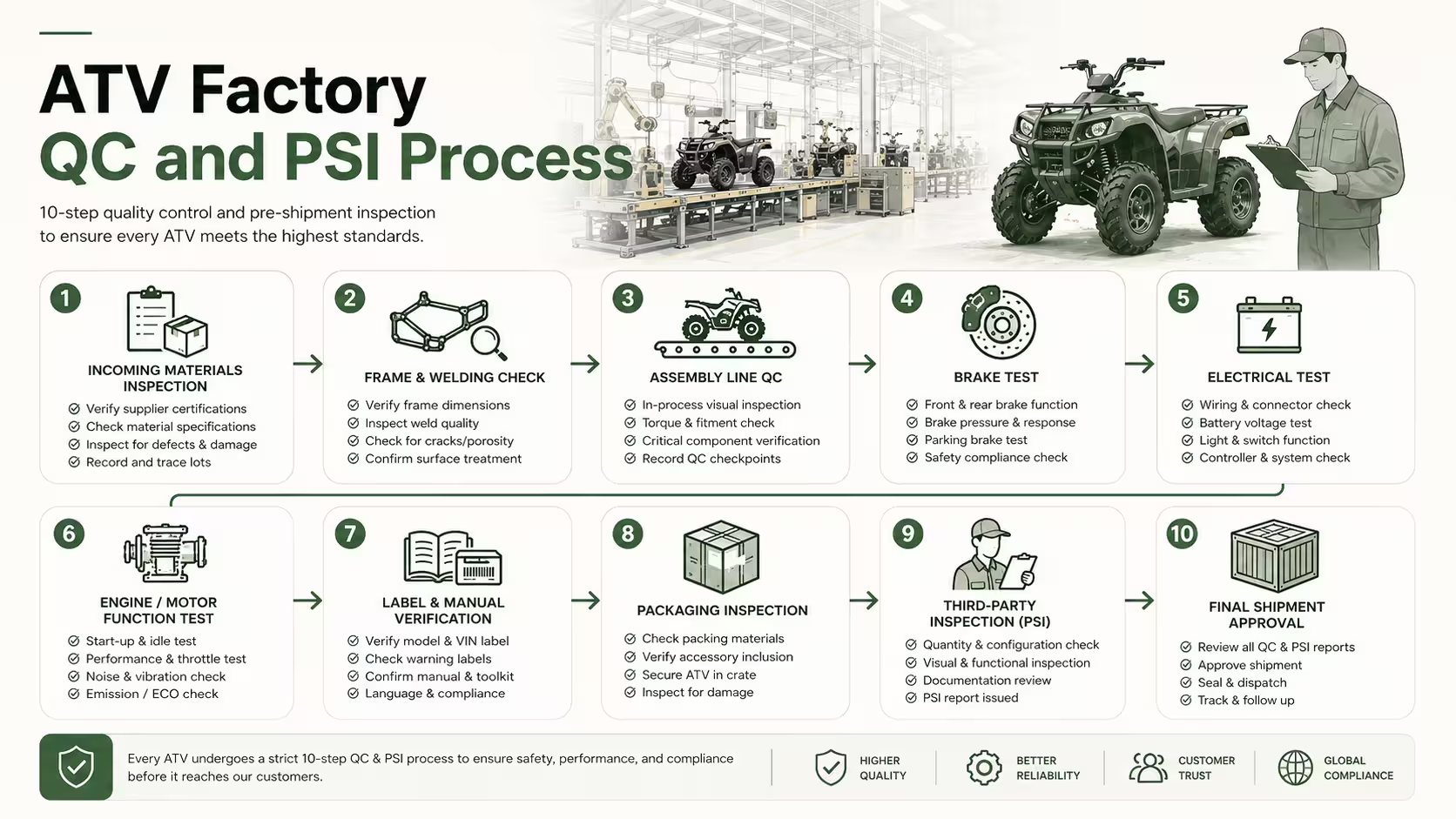
Quality control should be verified as a process, not accepted as a slogan. Wholesale buyers need to know what is checked, when it is checked, who checks it, how results are recorded, and whether third-party inspection is allowed.
| Inspection Area | What to Check | Evidence to Request |
|---|---|---|
| Model identity | Model name, frame number, engine or motor specification, configuration | Unit photos, nameplate photos, packing list |
| Quantity | Ordered quantity, model mix, color mix, spare parts quantity | Production report, packing list |
| Appearance | Plastics, paint, decals, frame finish, visible damage | Photos or inspection report |
| Assembly | Handlebar, wheels, brakes, suspension, controls, fasteners | PSI checklist, torque-check record where available |
| Electrical system | Lights, switches, battery connection, charging system where applicable | Function test record |
| Engine or motor function | Start test or power-on test, idle or throttle response where applicable | Test video or inspection report |
| Labels and manuals | Warning labels, compliance labels, user manuals, hangtags | Label photos, manual sample |
| Packaging | Crate, carton, protection, loose parts, battery handling | Packaging photos |
A reliable supplier should allow reasonable third-party inspection before shipment. Before production, clarify which inspection company may visit, when inspection can happen, what standard will be used, whether function checks are allowed, how defects will be corrected, and whether re-inspection is permitted.
PSI vs PDI: Pre-shipment inspection (PSI) happens before products leave the factory. Pre-delivery inspection (PDI) happens before the dealer or distributor delivers the ATV to the end user.
8Check Packaging and Container Loading Standards
Packaging is part of manufacturer reliability. Even a well-built ATV can create losses if it is poorly packed, loosely protected, or loaded without a clear plan. For wholesale buyers, packaging affects shipping damage, dealer assembly workload, parts loss, battery handling, and customer satisfaction.
| Packaging Area | What to Ask | Evidence to Request |
|---|---|---|
| Crate type | Is the ATV packed in steel crate, wood crate, carton, or another structure? | Packaging photos and crate specification |
| Unit protection | How are plastics, frame, controls, wheels, and exposed parts protected? | Close-up photos before carton closure |
| Loose parts | How are mirrors, tools, manuals, batteries, chargers, or accessories packed? | Loose parts packing photos |
| Battery handling | How are batteries packed, connected, disconnected, or documented where applicable? | Battery packing and label photos |
| Labeling | Are shipping marks, model labels, and buyer marks correct? | Carton and crate label photos |
| Container loading | Is there a loading plan by model and quantity? | Container loading plan and loading photos |
| Damage claim process | What happens if damage is found after arrival? | Written claim process and evidence requirements |
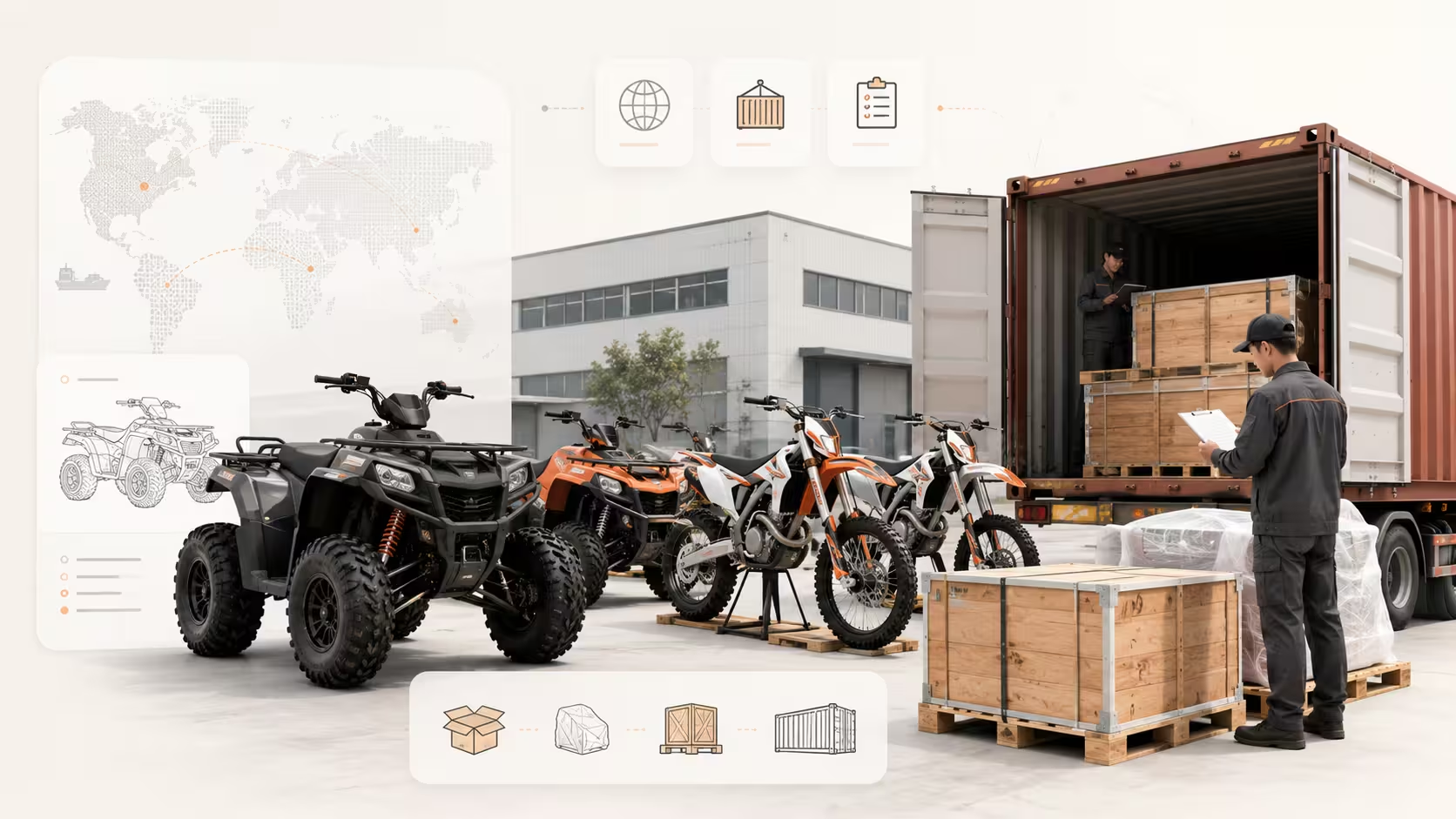
Before shipment, ask the manufacturer to provide a container loading plan showing model quantity, packaging dimensions, loading sequence, spare parts carton placement, protection method, shipping marks, and container photos after loading.
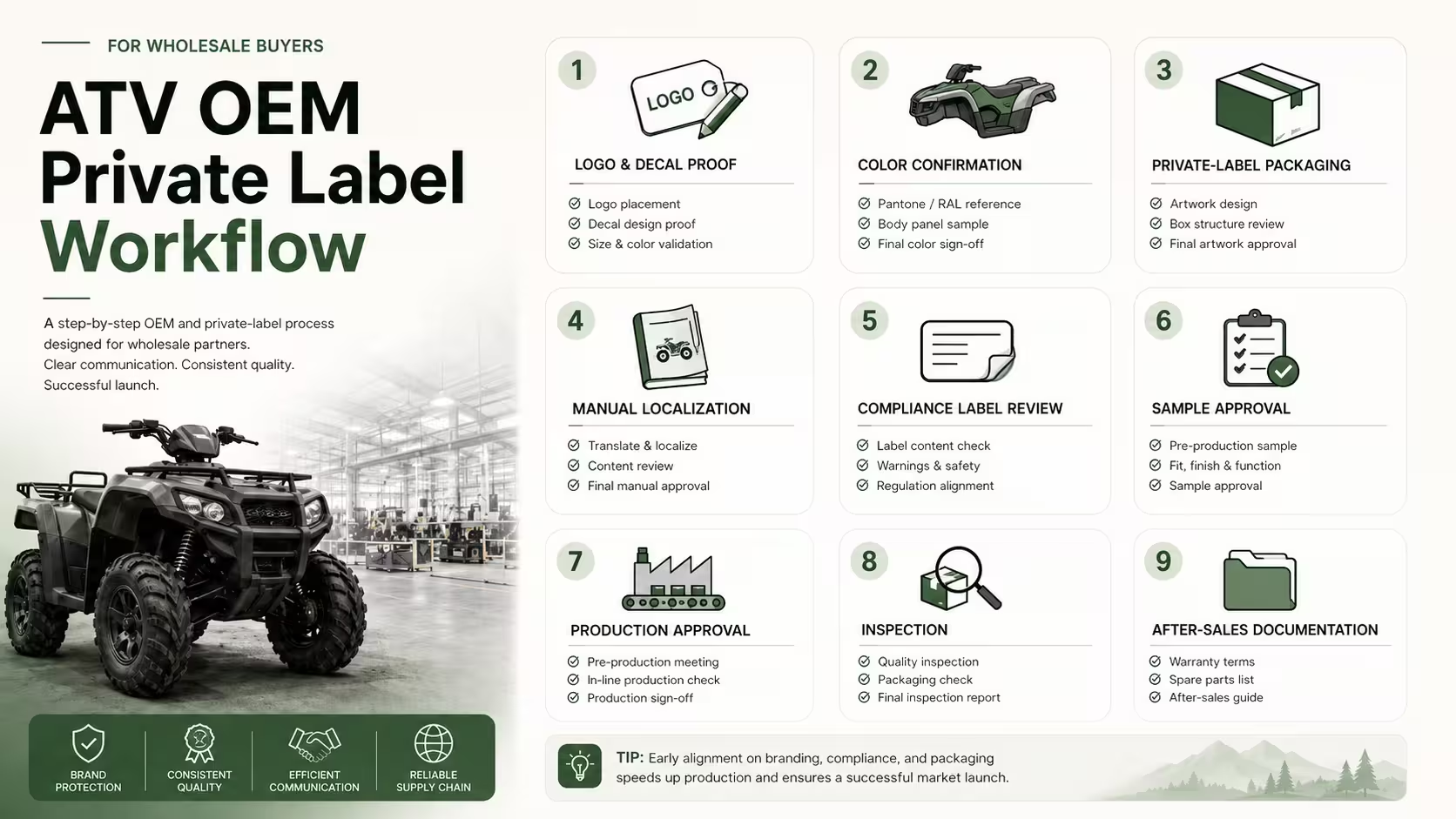
9Confirm OEM / Private Label Capability
OEM and private-label support should be verified as a manufacturing capability, not treated as simple logo decoration. Private label affects model continuity, documentation, packaging, compliance labels, warranty paperwork, and dealer materials.
| Area | What to Verify | Evidence to Request |
|---|---|---|
| Logo and decal support | Can the manufacturer apply buyer branding accurately and consistently? | Decal artwork proof, sample photos, placement guide |
| Color options | Are colors standard, optional, or custom? | Color samples, previous production photos, MOQ terms |
| Private-label packaging | Can packaging carry buyer branding and correct model information? | Packaging artwork, carton marks, crate photos |
| Manual localization | Can manuals be adapted for the buyer’s market and language? | Manual sample, editable file process, translation responsibility |
| Compliance label coordination | Can labels be reviewed before production? | Label artwork, label placement photos, approval workflow |
| Model continuity | Will the same model and parts remain stable across repeat orders? | Model change notice policy, parts compatibility notes |
| Final compliance documentation | Who prepares and signs required documents? | Written responsibility matrix for manufacturer, importer, or private labeler |
For U.S.-bound ATVs, buyers should confirm who is responsible for final compliance documentation before approving private-label production. A reliable manufacturer should be able to show a controlled OEM workflow: artwork review, sample confirmation, label approval, packaging confirmation, production approval, inspection, and after-sales documentation.
10Assess Dealer Support Materials
Dealer support materials help buyers verify whether the manufacturer is prepared for long-term wholesale cooperation. A supplier that only ships units but cannot support sales, service, parts, and claims may create extra workload for the importer or distributor.
- Product specification sheets
- High-resolution product photos and videos
- Owner’s manuals and service manuals where available
- Exploded parts diagrams and spare parts catalog
- PDI forms and warranty claim forms
- After-sales contact process and updated document sharing
The ATV Safety Institute Resources page can serve as a safety education reference for buyers building dealer materials. It should not be used as proof that any individual supplier is reliable.
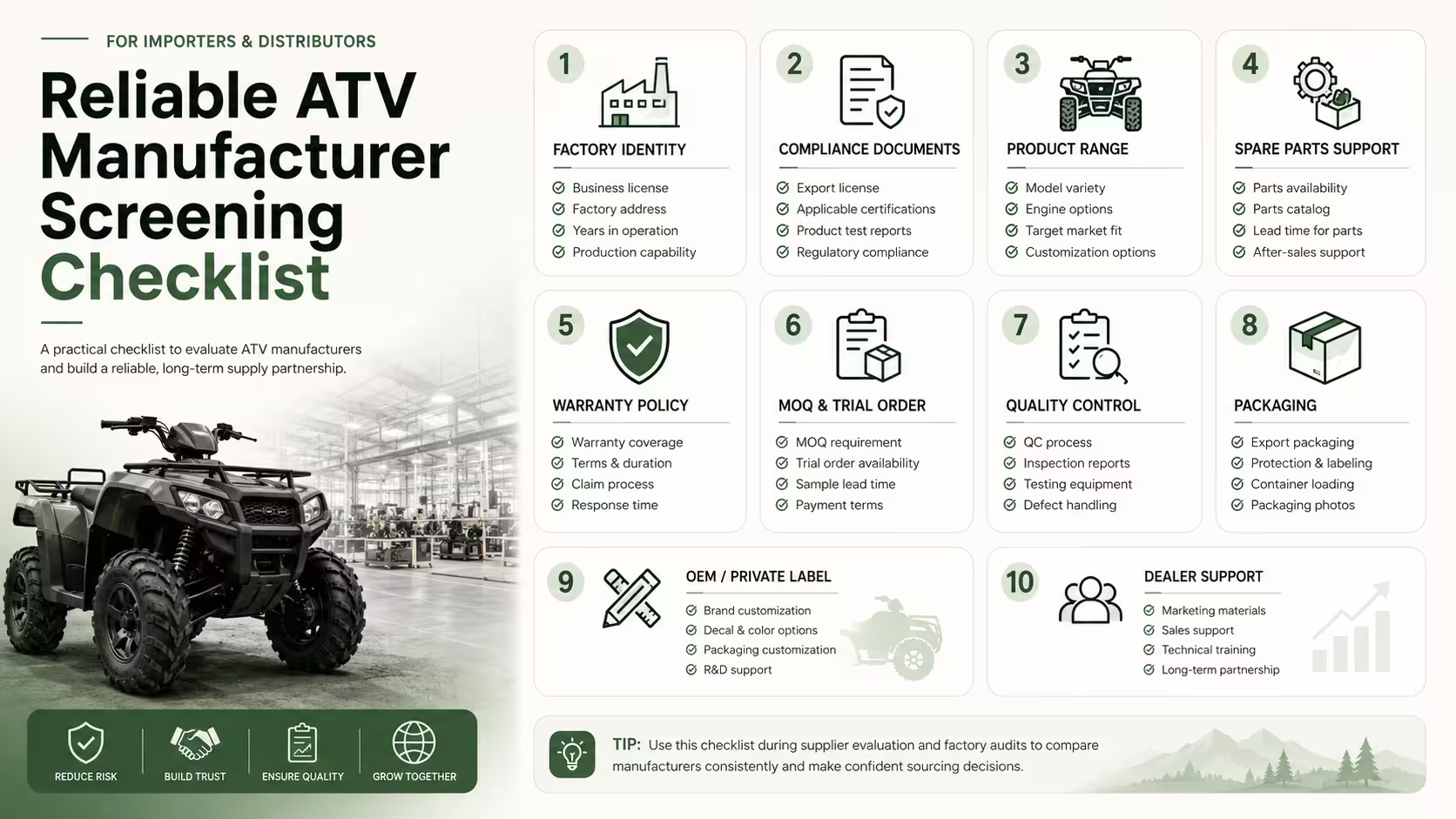
Reliable ATV Manufacturer Checklist
- Business license reviewed
- Factory address confirmed
- Production line evidence received
- Audit or third-party inspection allowed
- Engineering and technical team identified
- Export history reviewed
- Model-specific specification sheet received
- Target-market documents requested
- Action Plan status reviewed where applicable
- Labels, manuals, and certificates discussed before production
- Youth ATV category reviewed where applicable
- Final compliance responsibility confirmed
- Parts catalog and exploded diagrams received
- First-order parts kit discussed
- Written warranty policy received
- Claim evidence requirements confirmed
- Batch defect process discussed
- Dealer warranty form requested
- MOQ confirmed by model and configuration
- Sample or trial order reviewed
- Factory QC checklist and PSI process requested
- Third-party inspection allowed
- Packaging photos reviewed
- Container loading plan requested
- Logo and decal proof process confirmed
- Manual localization process discussed
- Compliance label coordination clarified
- OEM sample approval required
- Model continuity confirmed
- Documentation responsibility assigned
- Spec sheets available
- Product photos and videos available
- Owner’s manuals available
- PDI and warranty claim forms available
- After-sales contact process confirmed
- Updated document sharing process confirmed
Red Flags When Choosing an ATV Manufacturer
- Supplier only talks about low price
- Refuses factory audit
- No parts catalog
- No exploded diagrams
- No written warranty policy
- Refuses third-party inspection
- Cannot explain compliance documents
- Claims “certified for all markets”
- No packaging photos
- Changes model specs without notice
- No after-sales contact
- Cannot support dealer materials
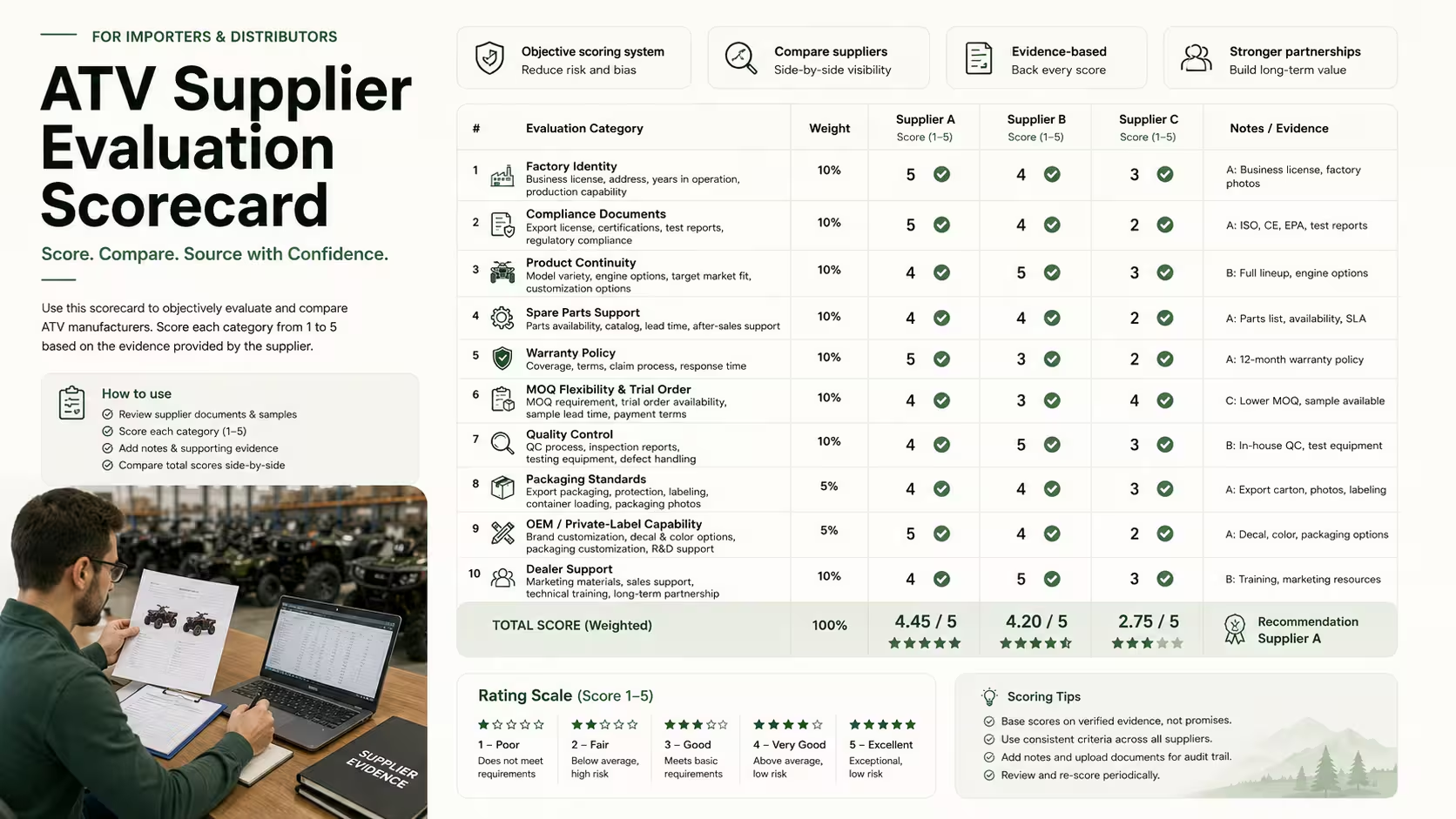
Supplier Evaluation Scorecard
| Criteria | Weight | What to Ask | Score 1–5 |
|---|---|---|---|
| Factory identity and auditability | 15% | Can the supplier prove factory identity, production site, audit access, and export history? | |
| Compliance documentation capability | 15% | Can the supplier provide model-specific documents for the target market? | |
| Product range and model continuity | 10% | Are models stable, repeatable, and supported across future orders? | |
| Spare parts support | 15% | Are parts catalog, exploded diagrams, parts codes, and warehouse support available? | |
| Warranty policy | 10% | Is the warranty written, practical, and clear for distributor or dealer use? | |
| MOQ and trial order flexibility | 5% | Can the buyer start with samples, trial batch, mixed container, or phased order? | |
| QC and pre-shipment inspection | 10% | Does the factory provide QC records, PSI checklist, and third-party inspection access? | |
| Packaging and loading standards | 5% | Can the supplier provide packaging photos, shipping marks, and container loading plan? | |
| OEM/private-label capability | 5% | Can the supplier control branding, manuals, labels, packaging, and approval workflow? | |
| Dealer support and after-sales process | 10% | Are manuals, photos, PDI forms, warranty forms, and after-sales contacts available? | |
| Total | 100% |
FAQ
1. How do I know if an ATV supplier is a real manufacturer?
Ask for evidence, not only a verbal claim. A real manufacturer should provide a business license, factory address, production line photos or videos, model list, QC process, engineering contact, parts warehouse evidence, and audit permission. A trading company may still be useful, but the buyer should know who controls production, specifications, parts, warranty, and documents.
2. What documents should I request from an ATV manufacturer?
Request model-specific documents, including the specification sheet, manuals, warning label artwork, packaging labels, test reports where applicable, parts catalog, exploded diagrams, warranty policy, PSI checklist, and relevant compliance documents for the target market. For U.S.-bound ATVs, review official CPSC sources and verify requirements by exact model and market.
3. Is the cheapest ATV manufacturer the best choice?
Not necessarily. A low FOB price may hide costs in weak packaging, poor spare parts support, unclear warranty terms, unstable model specifications, missing documents, or limited after-sales service. Wholesale buyers should compare total supplier risk, not just unit price.
4. How important is spare parts support for ATV distributors?
Spare parts support is critical because distributors and dealers need to keep units serviceable after sale. Before ordering, ask for a parts catalog, exploded diagrams, parts codes, a recommended first-order parts kit, and the parts ordering process.
5. Can I order private-label ATVs from a manufacturer?
Yes, many ATV manufacturers offer OEM or private-label options, but buyers should verify the workflow before production. Ask about decals, packaging, manual localization, warranty document branding, compliance label coordination, sample approval, OEM MOQ, and model continuity.
6. What should I check before choosing an ATV manufacturer for wholesale?
Before paying a deposit, verify factory identity, product specifications, compliance documents, spare parts support, warranty policy, MOQ terms, sample or trial order options, QC checklist, packaging photos, PSI process, and third-party inspection access. For OEM programs, also approve artwork, manuals, labels, and packaging details.
Conclusion
Choosing a reliable ATV manufacturer for wholesale is a supplier-screening process, not just a product selection process. A strong manufacturer should be able to prove factory identity, explain production capacity, support audits, provide model-specific documents, maintain spare parts, offer written warranty terms, cooperate with inspection, and support dealers after shipment.
Before confirming a bulk order, request the factory profile, model list, MOQ and sample terms, spare parts catalog, exploded diagrams, warranty policy, packaging photos, PSI checklist, compliance documents, and OEM/private-label options. These materials make supplier comparison easier and help buyers choose a partner that is reliable enough for long-term distributor cooperation.
Ready to screen your ATV supplier more effectively?
Request the factory profile, model list, MOQ and sample terms, spare parts catalog, warranty policy, packaging photos, PSI checklist, and OEM/private-label options before placing your next wholesale order.
Request wholesale ATV details