

2 Stroke vs 4 Stroke Dirt Bike: Why Do Heavier, Complex 4-Strokes Dominate?

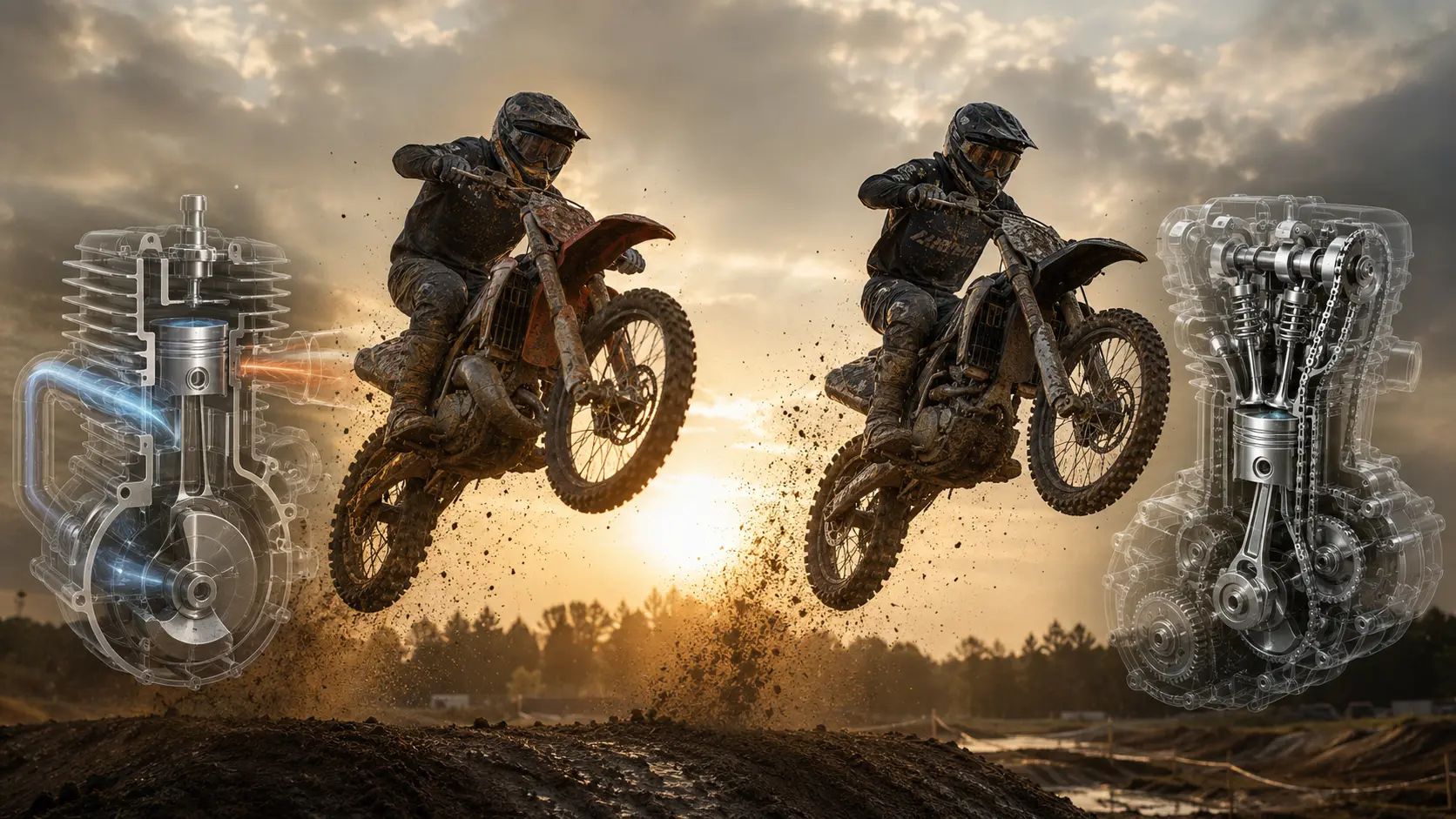
A 2-stroke dirt bike engine is lighter, simpler, and can hit nearly double the power density of a 4-stroke engine at the same displacement. Yet 4-stroke engines now power most dirt bikes on the market. Why did the heavier, more complex design win?
This question sits at the center of a decades-long contest between two engine types. Each design takes a different path to power, weight, and reliability. This guide walks through how both engines work. Then it explains why 4-stroke technology took over the mainstream dirt bike market — and where 2-stroke still holds its ground.
01 How Both Engines Work Together
Both engine types share one goal: turn burning fuel into rotating power at the rear wheel. Because of this shared goal, both engines use the same core parts:
- Cylinder
- Piston
- Connecting rod
- Crankshaft
- Crankcase
The piston moves up and down inside the cylinder. The connecting rod turns this motion into rotation at the crankshaft. The transmission and chain then send that power to the rear wheel.
So where do these two engines actually differ? Not in the parts above. The real difference comes down to four factors:
- How air enters the engine
- How exhaust leaves the engine
- How the combustion cycle runs
- How the engine gets its lubrication
These four factors — not the core parts — decide the weight, power delivery, maintenance needs, and best use case for every dirt bike engine.
02 The 4-Stroke Dirt Bike Engine Cycle
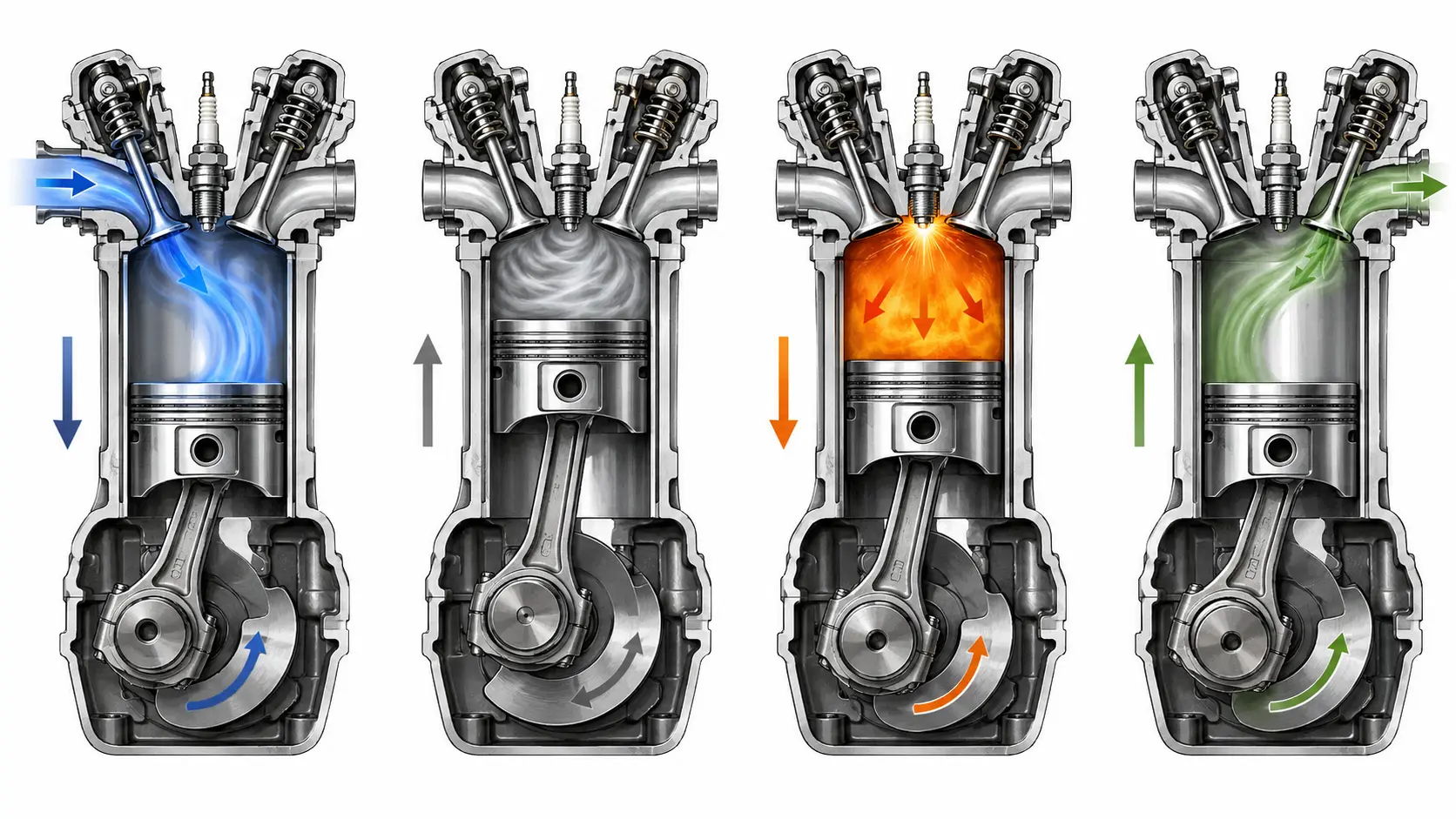
A 4-stroke engine completes one power cycle in four piston movements: intake, compression, power, and exhaust. Because of this four-step process, the crankshaft must turn twice to finish a single cycle.
1. Intake Stroke
The piston moves down from top dead center. This creates low pressure inside the cylinder. The intake valve opens, and a fresh air-fuel mixture flows in.
2. Compression Stroke
Next, the piston moves back up. The intake valve closes, so the mixture has nowhere to go. As the piston compresses the mixture, pressure and temperature both rise. Near the top of the stroke, the spark plug fires and ignites the mixture.
One common myth needs a correction here: combustion is not a simple explosion. It is a controlled, fast-burning process. The flame front spreads out from the spark point, and rising pressure pushes the piston down.
3. Power Stroke
This is the only stroke that produces usable power. Hot, high-pressure gas pushes the piston down and turns the crankshaft. As a result, chemical energy from the fuel becomes mechanical energy. This stroke is also why 4-stroke dirt bikes feel more predictable on hill climbs and rock crawls — the power release stays smooth and linear.
4. Exhaust Stroke
Finally, the piston moves up again. The exhaust valve opens, and the piston pushes spent gas out of the cylinder. One full cycle ends here, and the next intake stroke begins.
Why 4-Stroke Dirt Bikes Need a Complex Valve System
A 4-stroke engine controls intake and exhaust with valves. A camshaft, timing chain, or timing belt opens and closes these valves at exact moments. This precision keeps the engine stable across a wide range of RPM. It also explains why 4-stroke dirt bikes deliver smoother throttle response — a trait that suits beginners and long-distance trail riding.
This precision comes at a cost, though:
- More total parts
- A more complex build
- Higher overall weight
- More maintenance tasks, like valve clearance checks and timing inspections
03 The 2-Stroke Dirt Bike Engine Design
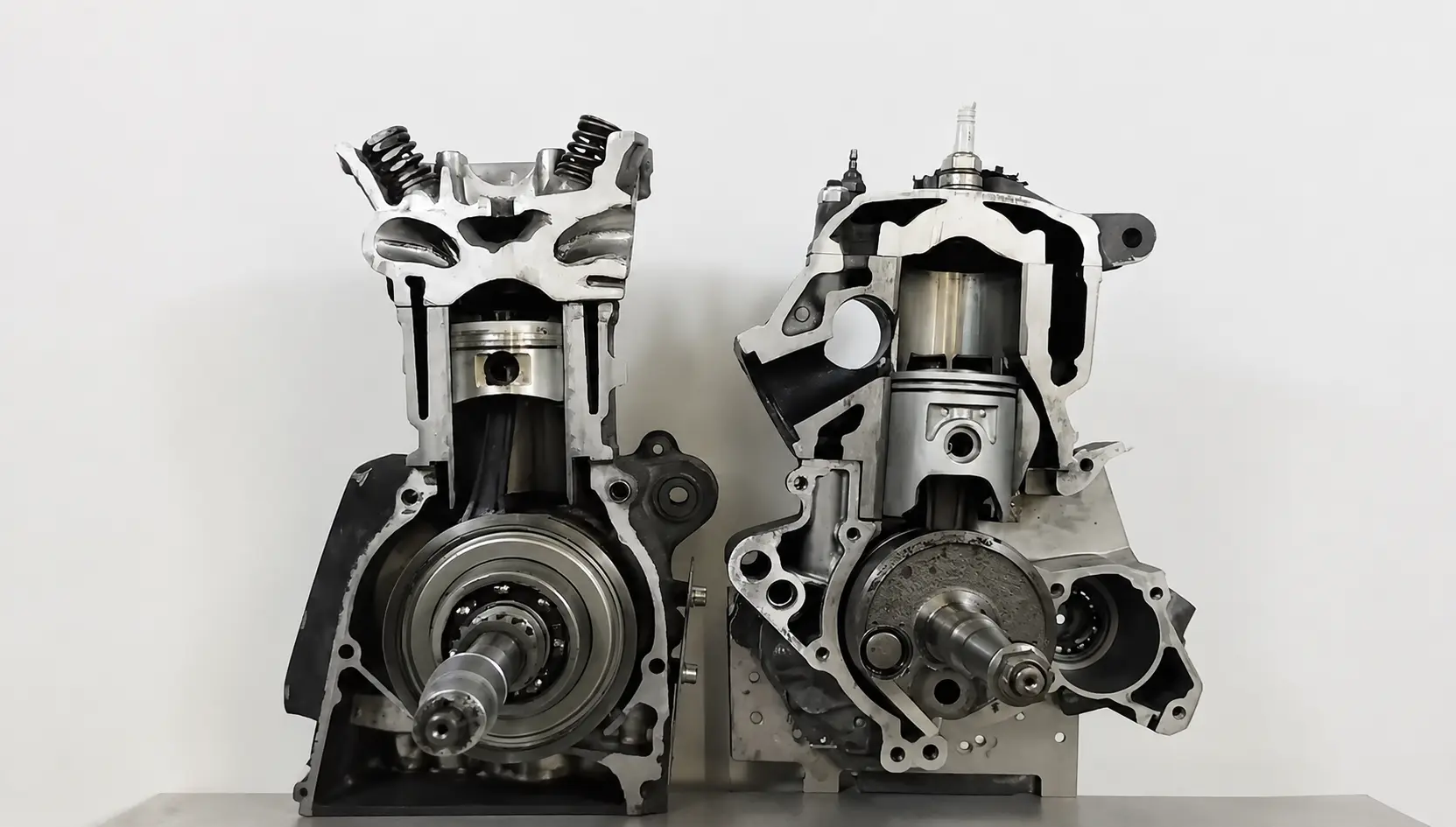
A 2-stroke dirt bike engine takes a completely different approach. Instead of a four-step cycle, it completes a full combustion cycle in just two piston strokes. To do this, it drops the camshaft, valve system, and timing gear entirely. Ports cut into the cylinder wall — intake, exhaust, and transfer ports — handle gas exchange instead.
Because it needs fewer parts, a 2-stroke engine weighs noticeably less than a 4-stroke engine of the same displacement.
How a 2-Stroke Engine Works
A 4-stroke engine only uses the combustion chamber above the piston. A 2-stroke engine uses two spaces at once: the chamber above the piston, and the crankcase below it.
Step 1 — Power and compression happen together. High-pressure gas from combustion pushes the piston down. At the same time, the piston’s downward motion compresses a fresh mixture waiting in the crankcase.
Step 2 — Exhaust and scavenging happen next. As the piston nears the bottom of its stroke, the exhaust port opens and spent gas leaves. Right after, the transfer port opens, and the fresh mixture from the crankcase sweeps in — pushing the last of the exhaust gas out.
Step 3 — Compression and intake happen together. The piston moves back up. Above the piston, it compresses the mixture and waits for ignition. Below the piston, low pressure in the crankcase pulls in a new charge of air and fuel.
Fig. 01 · Power Density
Power-to-Weight: 2-Stroke vs 4-Stroke at the Same Displacement
Power output varies by tuning, displacement, and specific model. This chart shows a general relative comparison between engine types, not figures for a single bike.
Because the crankshaft only needs one turn to complete a power stroke — instead of two — a 2-stroke engine can, in theory, produce nearly double the power of a same-size 4-stroke engine. This power-to-weight edge is exactly why 2-stroke dirt bikes dominated motocross and enduro racing for decades: a lighter chassis plus a stronger power pulse meant faster acceleration and sharper cornering.
This balance started to shift around 2000. According to the FIM sustainability policy overview, the governing body changed its displacement classes that year, grouping 250cc 2-stroke bikes against 450cc 4-stroke bikes in the same races. This rule change pushed manufacturers to shift their racing focus toward 4-stroke development.
04 2 Stroke vs 4 Stroke Dirt Bike: Pros and Cons
On paper, 2-stroke wins on power density and weight. But that simple design also comes with real trade-offs — ones that riders and manufacturers can’t ignore.
Lubrication and Engine Lifespan
A 4-stroke engine runs an independent lubrication system. The crankcase holds engine oil, and an oil pump circulates it to every moving part. This setup gives consistent, reliable protection.
A 2-stroke engine can’t do this, because its crankcase doubles as part of the intake path. It has no room to store a standing oil supply. Instead, it relies on fuel-mixed lubrication: 2-stroke oil gets mixed directly into the fuel. Some of that oil lubricates moving parts, and the rest burns off with the fuel.
This is why older 2-stroke dirt bikes produce blue exhaust smoke, a distinct smell, and more carbon buildup over time. Because lubrication depends on fuel flow rather than a dedicated oil circuit, parts like the piston and cylinder wear faster. Over time, this shortens the engine’s rebuild interval.
Fig. 02 · Service Life
Typical Rebuild Interval Range: 2-Stroke vs 4-Stroke
Rebuild intervals vary by riding style, maintenance quality, and model. This chart shows a general relative pattern between engine types.
Emissions Regulations
During the transfer/scavenging phase, fresh intake and exhaust gas overlap inside a 2-stroke engine. As a result, some unburned fuel and fresh mixture escape with the exhaust. This wastes fuel and raises hydrocarbon emissions.
In the United States, 40 CFR Part 1051 sets specific emission limits for recreational off-road engines, including dirt bikes. As more regions tighten emissions and noise rules for off-road vehicles, traditional carbureted 2-stroke dirt bikes struggle to stay compliant. This regulatory pressure is a major reason most mainstream manufacturers have trimmed their 2-stroke lineups.
Noise adds another layer of pressure. The FIM Sound Regulations set specific decibel limits for off-road racing disciplines like motocross and enduro. Bikes must pass a sound check before and after competition to stay eligible.
Fig. 03 · Emissions
Relative HC + NOx Emission Levels: 2-Stroke vs 4-Stroke
Emission levels vary by model year and certification standard. This chart shows a general relative pattern between engine types.
Power Delivery and Rider Control
A 2-stroke dirt bike often concentrates its power in a narrow, high-RPM band. Riders call this the “power hit.” Experienced racers enjoy this sharp, exciting delivery. But for beginners, or for tight technical sections like trail riding and rock climbs, that narrow power band is hard to manage. A 4-stroke engine’s wider, more linear torque curve is easier to control, and it takes less physical effort to ride over a long session.
05 Does the 2-Stroke Dirt Bike Have a Future?
Even though 2-stroke models make up a smaller share of showroom lineups today, they haven’t disappeared. They still hold a strong position in lightweight off-road bikes and youth models. Engineers also keep refining 2-stroke technology:
Power valves — By adjusting exhaust port timing, a power valve improves low-RPM usability and smooths out the power curve.
Fuel-injected 2-stroke systems — Some manufacturers now build 2-stroke engines with electronic fuel injection to cut fuel loss and emissions. In 2017, KTM announced its TPI (Transfer Port Injection) system, the world’s first production 2-stroke enduro engine with fuel injection (launched on the 250/300 EXC TPI models). Instead of premixing fuel and oil, TPI places injectors at the transfer ports — cutting fuel consumption and emissions while keeping the simple rebuild process 2-stroke owners rely on. This technology still sits mostly in a handful of high-end models, and exact specs vary by manufacturer.
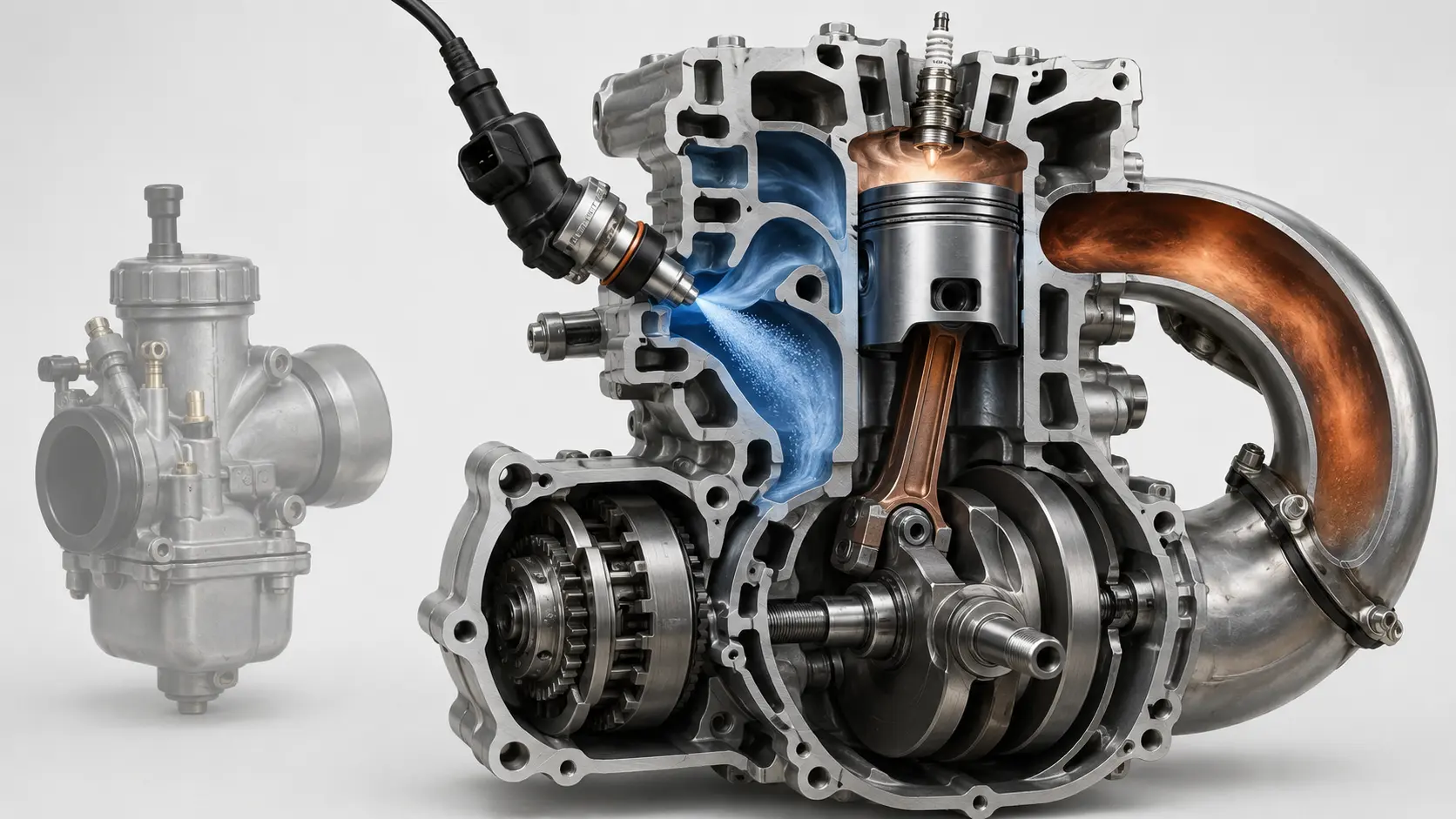
These upgrades keep 2-stroke dirt bikes competitive in specific niches: lightweight racing, entry-level riding, and any use case where weight matters more than anything else.
06 Final Comparison
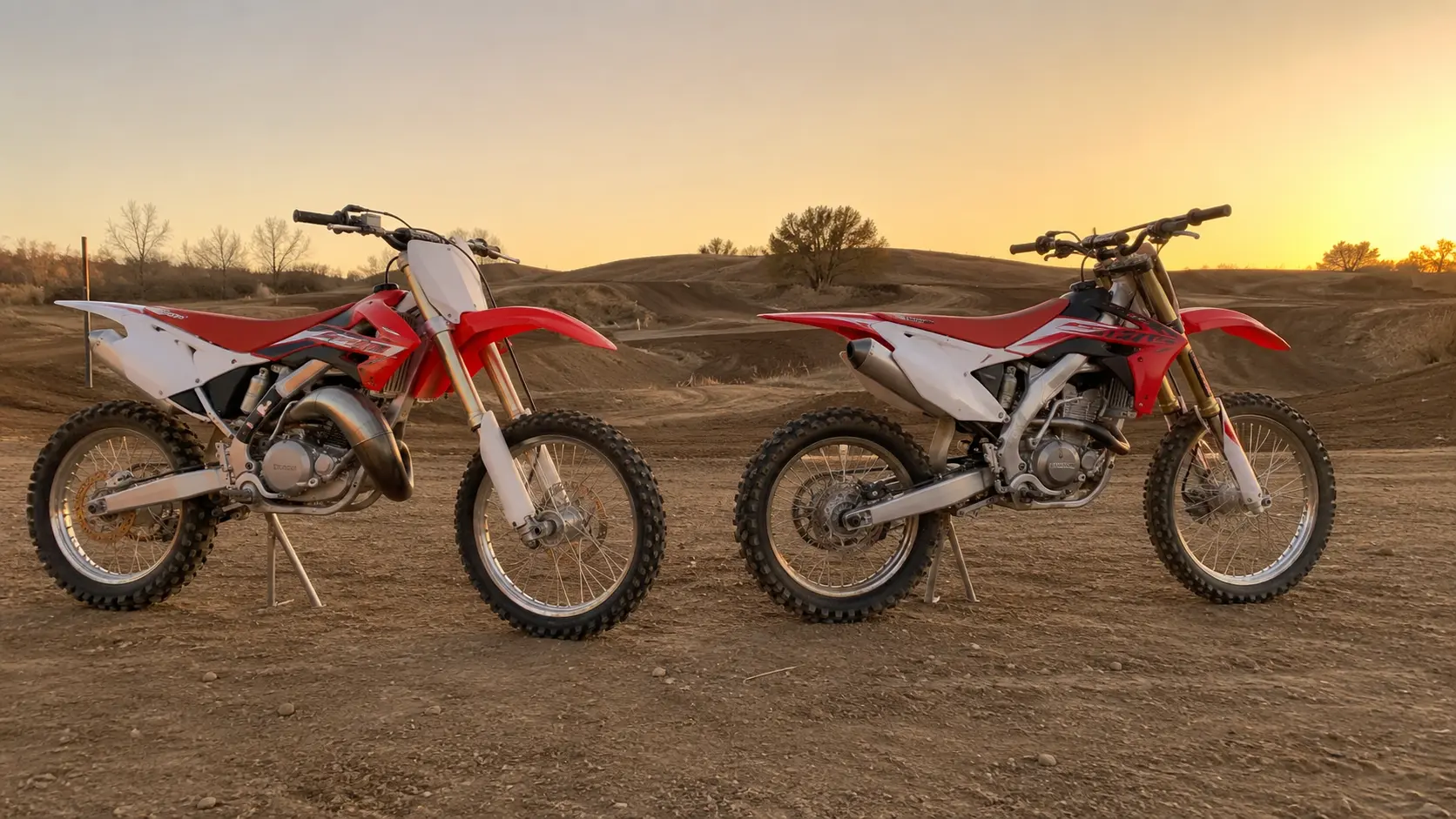
A 2-stroke dirt bike works like a sharp, lightweight off-road tool. A 4-stroke dirt bike works like a balanced, long-term workhorse. Here’s how the trade-offs stack up:
2-Stroke
- Lighter overall weight
- Simple design, fewer failure points
- Higher power density, sharp acceleration
- Lower repair cost per fix
- Higher fuel use and carbon buildup
- Tighter emissions and noise compliance
- Shorter rebuild interval
- Steeper learning curve for power control
4-Stroke
- Linear, easy-to-control power delivery
- Lower emissions and noise output
- Longer service life, longer rebuild interval
- Better fit for beginners and long trail rides
- Heavier overall weight
- More complex design, more parts to maintain
- Higher upfront manufacturing cost
Fig. 04 · Overall Balance
Weight, Power Density, Emissions, Maintenance Cost, Ease of Control
This radar chart shows a general relative comparison across five factors, not scores for a specific model.
A 4-stroke engine costs more to build and weighs more on the scale. Even so, it matches what most riders need today: control, durability, compliance, and a lower cost of ownership over time. That’s why 4-stroke engines now serve as the standard across most displacement classes in the dirt bike market. 2-stroke models, meanwhile, hold their ground in lightweight racing, youth bikes, and other niches where low weight beats everything else.
The 2-stroke engine didn’t lose this race on power. It lost on overall balance. This decades-long competition was never really about which engine hits harder — it was about which engine balances power, control, reliability, and emissions compliance the best.
FAQ Common Questions
Neither engine is better in every situation. A 2-stroke dirt bike gives you a lighter chassis, sharper acceleration, and lower repair costs, which makes it a strong pick for racing and lightweight off-road use. A 4-stroke dirt bike gives you smoother power, better emissions and noise compliance, and a longer service life, which suits beginners, trail riders, and daily use. The right choice depends on your skill level, riding terrain, and local regulations.
At the same displacement, a 2-stroke dirt bike usually accelerates faster because it fires on every crankshaft rotation, while a 4-stroke fires on every second rotation. On top speed and overall lap times, a modern 4-stroke can match or beat a smaller 2-stroke thanks to its wider torque band and better traction control. This is why race series often pair a 250cc 2-stroke against a 450cc 4-stroke in the same class.
Yes, but the maintenance work is different in nature. A 2-stroke dirt bike needs top-end rebuilds more often because its lubrication mixes with the fuel and burns off. Each rebuild, however, is cheaper and faster than a full 4-stroke rebuild. A 4-stroke needs less frequent internal work, but it adds regular tasks like valve clearance checks, timing chain inspections, and oil changes with a dedicated oil circuit.
A 2-stroke dirt bike fires once per crankshaft rotation, so its exhaust pulses hit twice as often as a 4-stroke at the same RPM. This creates the sharp, high-pitched “ring-ding” sound most riders recognize. A 4-stroke fires half as often and adds valve motion into the mix, so its exhaust note sounds deeper and more even.
A 4-stroke dirt bike usually works better for trail riding. Its linear torque curve makes it easier to control at low speeds through tight sections, roots, and rocks. Its longer rebuild interval also fits the higher hour count trail riders often log. A 2-stroke can still work well for lighter, more experienced trail riders who prefer the reduced weight and don’t mind managing the sharper power delivery.
Yes. Major manufacturers still build 2-stroke dirt bikes for racing classes, youth models, and lightweight off-road segments. Some brands have also released fuel-injected 2-stroke enduro bikes — like KTM’s TPI models — to meet stricter emissions rules while keeping the weight and simplicity advantages of the 2-stroke design.
Compare our 300cc 4-stroke dirt bike lineup for wholesale programs, dealer inventory planning, and regional off-road motorcycle supply.
View 300cc 4-stroke wholesale options